Having a website isn’t enough anymore. If customers can’t find you on Google, your business might as well be invisible. In 2026, Nigerian businesses are realizing that visibility is currency.
I’ve picked seven tools that close that gap, with current prices and the order I’d set them up in for a Nigerian business. Most have a free option.
Why SEO Tools Matter for Businesses in Nigeria
SEO tools matter because they show what customers search for, what your site does with that traffic, and what competitors already rank for. Four benefits stand out.
They Replace Guesswork With Data
SEO tools show which keywords bring visitors, which pages need work and how your content performs. You stop guessing which blog post to write next.
They Show What Your Competitors Rank For
Competitors don’t rank by chance. Ahrefs and Semrush list the keywords a rival ranks for, so you can spot gaps and fill them.
They Win Local Searches
Phrases like “best salon in Surulere” or “restaurant near Ikeja” carry a location and a buying intent. Google Business Profile and Search Console show whether your business appears for them.
They Save Time
Keyword research, site audits and reports can run on a schedule, which frees a small team for strategy and content. Say a Lagos fashion store finds that shoppers search “affordable Ankara dresses.” Using that exact phrase on product pages and social posts reaches people who are already looking to buy.
What Are the 7 Best SEO Tools for Nigerian Businesses in 2026?
Three Google tools cover tracking and local visibility for free, and four more handle keywords, competitors and on-page work. Prices below are US dollar list prices, so your naira cost moves with the exchange rate.
|
Tool |
Cost |
Best for |
|
Google Search Console |
Free |
Seeing which searches and pages bring Google traffic |
|
Google Analytics 4 |
Free |
Tracking what visitors do and which channels convert |
|
Ahrefs |
Free plan; paid from $129 a month |
Competitor and backlink research |
|
Ubersuggest |
Limited free use; $29 a month |
Beginner keyword research |
|
Semrush |
From $139.95 a month |
Tracking many keywords or sites in one place |
|
Yoast SEO |
Free plugin; Premium is paid |
On-page optimization in WordPress |
|
Google Business Profile Performance |
Free |
Local search visibility |
Google Search Console (Free)
Google Search Console is the first tool to set up, because it shows how Google sees your site.
- Impressions, clicks, click-through rate and average position for each search query and page.
- A page indexing report that lists pages Google couldn’t index.
- Sitemap submission, so new pages get found faster.
Google retired the Mobile Usability report on 1 December 2023. To check how a page performs on a phone, run Lighthouse in Chrome instead.
It’s free, and the data comes straight from Google. That holds whether you run an online store in Abuja or a service business in Port Harcourt.
Tip: Open the Performance report weekly and find queries with many impressions but few clicks. Rewrite the title and meta description of those pages, then create more content around the queries that already work.
Google Analytics 4 (Free)
Google Analytics 4 (GA4) shows what visitors do after they land and which channel sent them.
- Traffic sources, such as Google search, social media and ads.
- Behavior: pages visited, engagement time and where people leave.
- Key events, such as purchases, form submissions and bookings.
- Device and location data, which matters on a site where most visits come from phones.
Google now calls conversions “key events”, so look for that label in your reports.
Many Nigerian businesses run ads or SEO campaigns without knowing whether they lead to sales. GA4 connects the click to the customer.
Say a Lagos spa finds that most bookings follow the path Instagram, then the website, then the booking page. It can put more into Instagram content and trim spend elsewhere.
Tip: Mark “Book Now” clicks and form submissions as key events, so you can see which channels deliver real enquiries.
Ahrefs (Paid, with Free Tools)
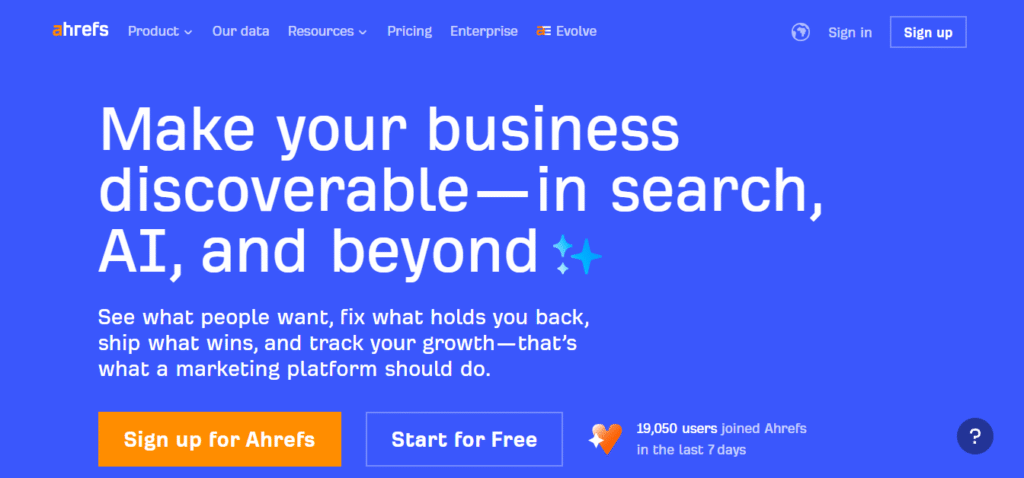
Ahrefs is the strongest tool here for competitor and backlink research, and its free plan is useful for your own site.
- Site Explorer: see which keywords a competitor ranks for and where its traffic comes from.
- Content Gap: find keywords competitors rank for that you don’t.
- Keyword Difficulty: see how hard a search term is to rank for.
- Backlink checker: track who links to you and spot chances to earn more links.
The free plan, Ahrefs Free (formerly Ahrefs Webmaster Tools), scans your verified websites for 170+ technical and on-page SEO issues. The paid Lite plan costs $129 a month and includes 5 projects, 750 tracked keywords and 6 months of historical data.
Say a Lagos real estate company checks which competitors rank for “flats in Lekki Phase 1.” It can then build landing pages around the same searches.
Tip: If budget is tight, verify your own site in Ahrefs Free before paying for anything.
Ubersuggest (Freemium)
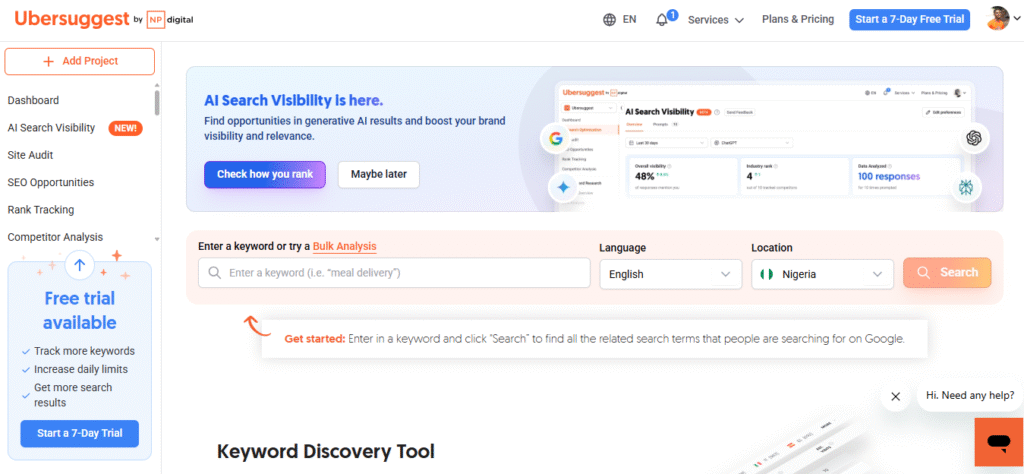
Ubersuggest is the simplest paid keyword tool for beginners, and the Individual plan costs $29 a month or $290 for a lifetime plan.
- Keyword research: search volume and ranking difficulty for each term.
- Content ideas: blog and video topics based on a keyword.
- Competitor pages: the top pages driving a rival’s organic traffic.
It lets you choose a country for each search. In our own work with clients, volume data for hyperlocal Nigerian phrases is often thin in every keyword tool, so I check ideas against Search Console queries before writing.
Say a catering brand uses it to find topics like “best small chops ideas for Nigerian weddings” and “how to plan a Lagos outdoor event menu.” Those posts target people who are planning an event.
Tip: Target long-tail phrases such as “affordable catering service in Lekki.” Ahrefs’ 2025 study found it takes longer to rank for high-volume keywords than low-volume ones.
SEMrush (Paid)
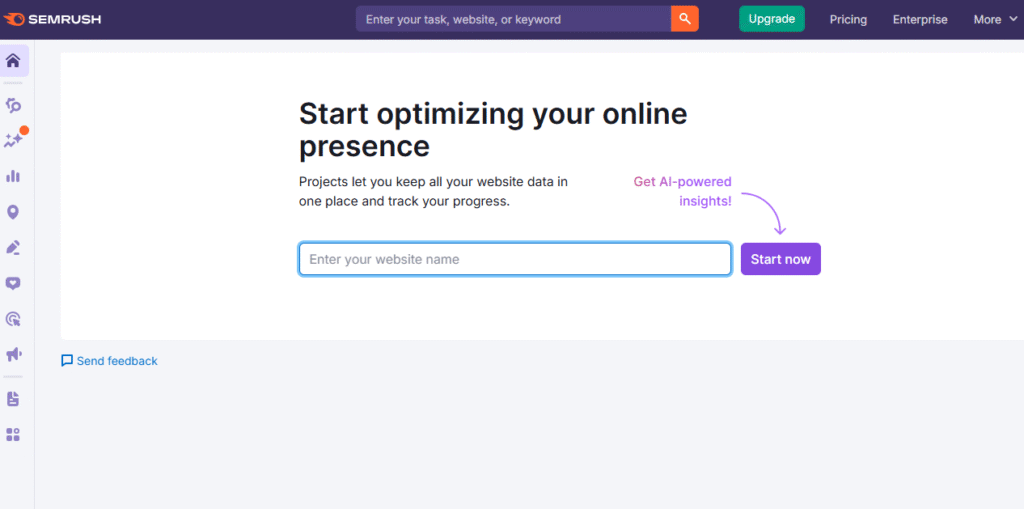
Semrush is an all-in-one platform for teams that track many keywords or manage several websites, and the Pro plan costs $139.95 a month ($117.33 billed annually).
- Keyword tracking: see where you rank on Google and how that changes over time.
- Competitor analysis: find the keywords and content your rivals rank for.
- Site audits: catch broken links and slow pages. Pro crawls up to 100,000 pages a month.
Content tools and deeper historical data sit in the Guru plan at $249.95 a month. Brand Monitoring is a separate app, listed at $79 a month for three queries in Semrush’s knowledge base.
It suits agencies, startups and mid-sized businesses such as real estate firms, tech companies and e-commerce stores. A solo owner with one site will get more value from the cheaper tools above.
Tip: For free brand-mention alerts, Google Alerts covers smaller brands, though it isn’t real-time. Use any mentions you find on Nigerian blogs or news sites to start partnership or backlink conversations.
Yoast SEO (Free WordPress Plugin)
Yoast SEO is a WordPress plugin, so it only helps if your site runs on WordPress.
- SEO analysis: checks how well a post uses your target keyword.
- Readability analysis: flags long sentences, passive voice and complex phrasing.
- Meta tag editing: controls how your page appears in Google results.
- XML sitemaps: generated automatically.
Yoast’s traffic-light system (red, orange, green) makes the feedback easy to read. Internal linking suggestions, redirect management and extra focus keywords belong to Yoast Premium, not the free plugin.
Tip: Preview each post in Yoast before you publish and aim for green on SEO and readability. A green light means the checklist is met. It doesn’t guarantee a ranking, so keep checking Search Console afterwards.
Google Business Profile Insights (Free)
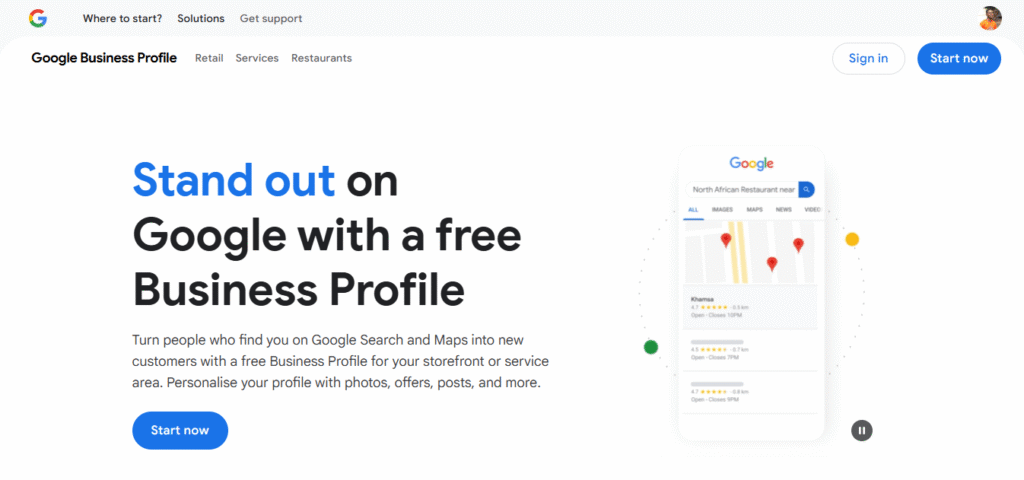
Google Business Profile Performance shows how customers find your business on Google Search and Maps and what they do next. Google renamed the old Insights section to Performance.
- Calls, direction requests and website clicks from your profile.
- The search terms people used to find you.
- Direct searches (your business name) versus discovery searches (a service or category, such as “spa near Lekki”).
Service-area businesses without a public address won’t see direction requests.
For restaurants in Ikeja or salons in Port Harcourt, this is the tool behind “near me” visibility. Oxgital set up and fully optimized Renik Energy’s Google Business Profile and managed its reviews, as the Renik Energy SEO case study explains.
Tip: Add fresh photos or a current offer, then watch whether calls and website clicks rise in the Performance report.
What Order Should You Set Up These SEO Tools In?
Set up tracking first, research second, on-page work third and local visibility last. Here’s the sequence I’d follow:
- Set up Google Search Console and GA4, then link them. You need to be a verified owner in Search Console and an editor in GA4. The link puts search queries beside visitor behavior.
- Research 5 to 10 long-tail keywords. Use Ubersuggest or Ahrefs and pick phrases like “affordable skincare products in Lagos.”
- Optimize your top 3 pages. If you’re on WordPress, use Yoast SEO to update titles, meta descriptions and readability.
- Create or claim your Google Business Profile. Add photos, location details and posts, so you can appear in “near me” searches.
- Review monthly. Check which pages attract visitors, which queries drive them and where to improve.
Oxgital followed this order for Renik Energy. The team researched how Nigerians search for solar, built service pages around those searches, optimized the Google Business Profile and wrote content for high-intent questions.
What Mistakes Do Nigerian Businesses Make With SEO Tools?
Most mistakes come from using the tools without a clear question to answer. These five cost businesses the most:
- Reading vanity numbers. Page views and likes feel good, but leads and sales pay the bills. Track key events in GA4.
- Using too many tools without direction. Jumping between platforms creates confusion. Master two or three before you add more.
- Not linking GA4 with Search Console. Without the link, you can’t see search impressions next to what visitors did on your site.
- Copying foreign keyword strategies. Nigerians search in their own words, such as “home inverter installation services” and “solar installation in Lagos.” Check each phrase against your Search Console queries.
- Neglecting mobile and local SEO. Mobile made up 53.09% of Nigerian web traffic in August 2026, so slow pages hurt most visitors first. An unclaimed Google Business Profile costs you local searches.
Which SEO Tools Should You Start With?
Start with Google Search Console, Google Analytics 4 and Google Business Profile. All three are free, and used well they take a small business a long way.
Add Yoast SEO if you’re on WordPress, then pay for Ubersuggest, Ahrefs or Semrush once you have questions the free tools can’t answer. See how Oxgital applies this to real accounts in its SEO and marketing project case studies.
If you’d rather have someone read the data for you, talk to Oxgital about an SEO audit and strategy built around your goals. The team’s SEO services cover the research, on-page work and local setup described above.