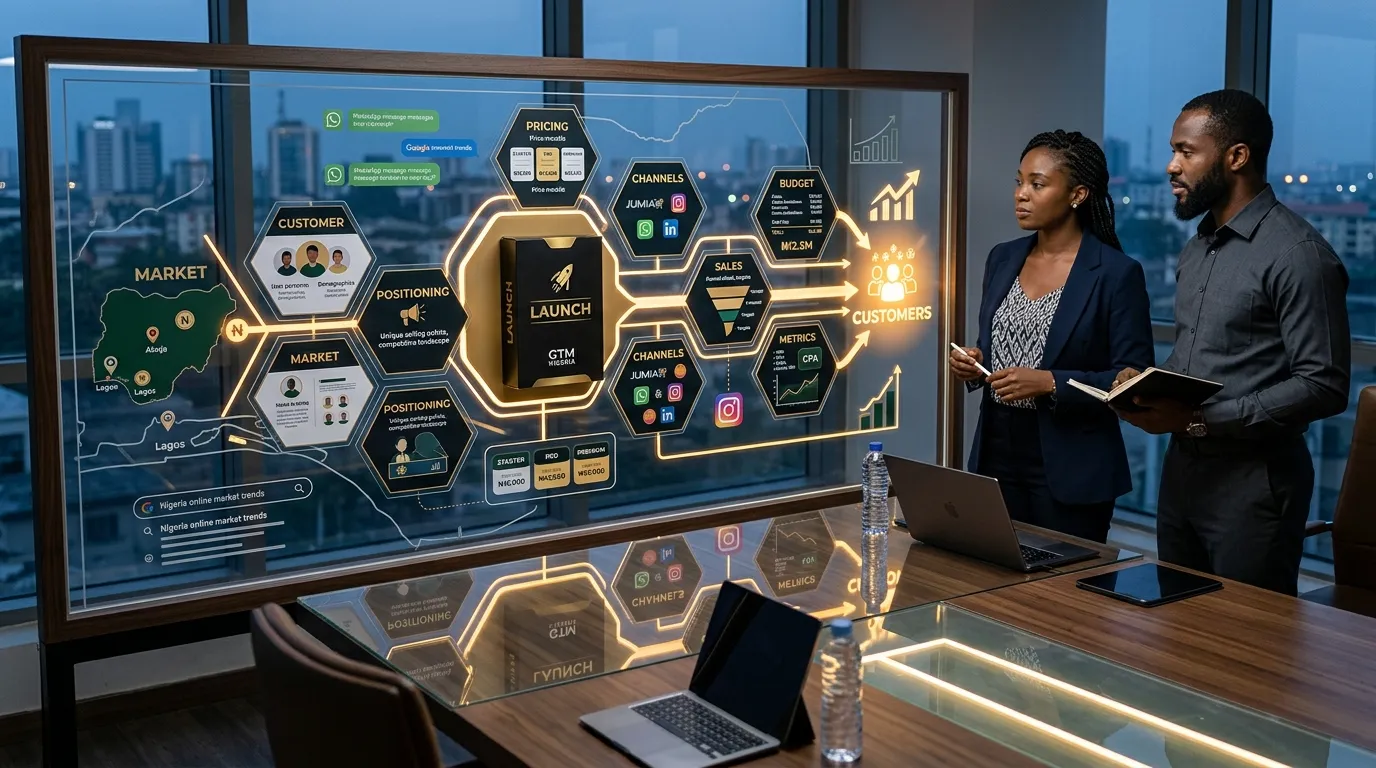
Fewer than 3,200 registered dentists are serving a country of over 200 million people, and the Nigerian Dental Association’s president has said one dentist now treats roughly 54,000 Nigerians, against a recommended ratio of 1 to 5,000. That statistic should mean every dental clinic in Lagos, Abuja, and Port Harcourt has a waiting list. Most don’t. Walk into a private clinic on a random Tuesday, and you’ll find a receptionist scrolling her phone and three empty chairs.
We’ve sat across the table from enough clinic owners at Oxgital to know why. The demand exists. The marketing doesn’t connect to it. A patient with a toothache at 9pm searches “dentist near me open now” or asks a Lagos parents’ WhatsApp group for a recommendation, and the clinics without a Google Business Profile, a working website, or an active referral system simply don’t exist to that patient. They lose a booking they never knew was available.
This isn’t a general healthcare marketing guide dressed up for Nigeria. It’s built around how Nigerian patients actually search, chat, and choose, from WhatsApp-first communication to the trust gap patients carry into every unfamiliar clinic.
By the end, you’ll have 15 specific strategies you can start applying this week, in the order that gets you booked patients fastest, not just website traffic.
Why Dental Marketing in Nigeria Doesn’t Look Like Dental Marketing Anywhere Else
A dental marketing playbook written for Chicago or London assumes things that don’t hold here. It assumes patients trust their insurer to point them to a good dentist. It assumes email is a primary channel. It assumes a slow website costs you conversions but not the entire visit.
None of that applies in Lagos. Most patients pay out of pocket or through an HMO they don’t fully understand, so trust has to be earned before the first appointment, not verified by a third party. Nigeria had 109 million internet users at the end of 2025, at 45.5 percent penetration, and nearly all of them are on mobile data, which means a clinic website that takes eight seconds to load on a weak MTN connection has already lost the patient before the homepage finishes rendering.
And then there’s WhatsApp. Krestel Digital’s 2026 data puts WhatsApp usage at 96.5 percent among Nigerian internet users aged 16 and above, well ahead of every other platform. If your clinic’s “contact us” page only offers a phone line and a contact form, you’re asking patients to behave like Americans in 2015.
We asked around in a few Nigerian small-business communities about what actually frustrates people trying to book a dentist here, and the pattern was consistent: nobody trusts a clinic that goes quiet after the first message.
That distrust is the real obstacle. Every strategy below is built to close it, not just to generate more clicks.
1. Fix Your Google Business Profile Before You Touch Anything Else
If a patient searches “dentist in Ikeja” or “dental clinic near me,” Google Maps decides who they see first, and most clinics haven’t claimed or updated their listing in over a year. This is the single highest-leverage fix available, and it costs nothing but time.
Get your clinic name, address, and phone number identical across your website, Google listing, and every directory you’re on. Add real photos of your reception area and treatment rooms, not stock images of a smiling model with implausibly white teeth. List your actual opening hours, including whether you take walk-ins on Saturdays, because that single detail decides a lot of same-day bookings in Nigeria.
Respond to every review within 48 hours, good or bad. A clinic that replies calmly to a one-star review about a long wait time looks more trustworthy than one with only five-star silence. We handle this as part of our reputation management work with clients, because an unattended profile quietly costs more bookings than a bad ad campaign ever will.
2. Build a Website That Converts, Not Just Exists
A lot of Nigerian dental clinics have a website because someone told them they needed one, not because it does anything. It lists services, has a nice hero image, and stops there. No booking button above the fold. No WhatsApp click-to-chat. No page is dedicated to the one procedure that actually pays the bills, like implants or Invisalign.
Every service page should answer three things in the first 100 words: what the procedure treats, roughly what it costs (or a clear range), and how to book it today. Nigerian patients researching implants or braces are comparing three or four clinics in one sitting, often on a phone with 40 percent battery, and the clinic that answers fastest usually wins the booking regardless of who has the better reviews.
This is core website development work, and we built exactly this kind of conversion-focused site for Laide Gbadamosi & Co., a law firm where the same principle applied: professional-services patients and clients decide fast when the information they need is right in front of them.
3. Rank for the Searches Nigerian Patients Actually Type
Most dental SEO advice targets searches like “best toothpaste for sensitive teeth,” which brings traffic but rarely a booking. The searches that convert are narrower: “tooth extraction cost Lagos,” “emergency dentist Lekki open now,” “braces for adults Abuja price.” These have lower volume and far higher intent.
Build a page for each procedure you actually perform well, with the city or neighbourhood named directly in the title and first paragraph. Google’s local algorithm rewards that specificity, and so does the patient scanning search results at midnight with a swollen jaw. SEO matters more for small businesses in Nigeria than in saturated markets precisely because so few competitors are doing it properly, which means the clinic that shows up consistently for these searches often ends up ranking with far less effort than you’d expect.
Pair this with technical basics: fast load times, mobile-first design, and a Google Business Profile that matches your website exactly. Our search engine optimisation work always starts here before we touch content, because ranking for the wrong keywords is worse than not ranking at all.
4. Turn WhatsApp Into Your Real Booking Channel
Nigerian patients don’t want to fill out a contact form and wait for a callback. They want to type “Do you have space tomorrow morning?” into WhatsApp and get an answer in minutes. Clinics that treat WhatsApp as an afterthought are losing bookings to clinics that treat it as the front desk.
Set up WhatsApp Business with a catalog of your top procedures, automated greeting messages for after-hours enquiries, and quick-reply templates for the five questions you get asked every single day, like cost, location, and whether you accept a specific HMO. A patient messaging at 10pm should get an automatic reply confirming their message was received and giving them a rough response window, because silence for six hours reads as “this clinic doesn’t care.”
Add a WhatsApp click-to-chat button to every page of your website, not buried in a footer. This one change alone tends to move more bookings than most paid ad campaigns we’ve run for service businesses.
5. Use Instagram and TikTok for Before-and-After Proof, Not Vanity Content
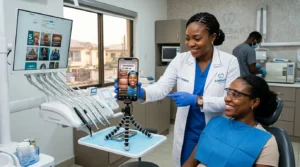
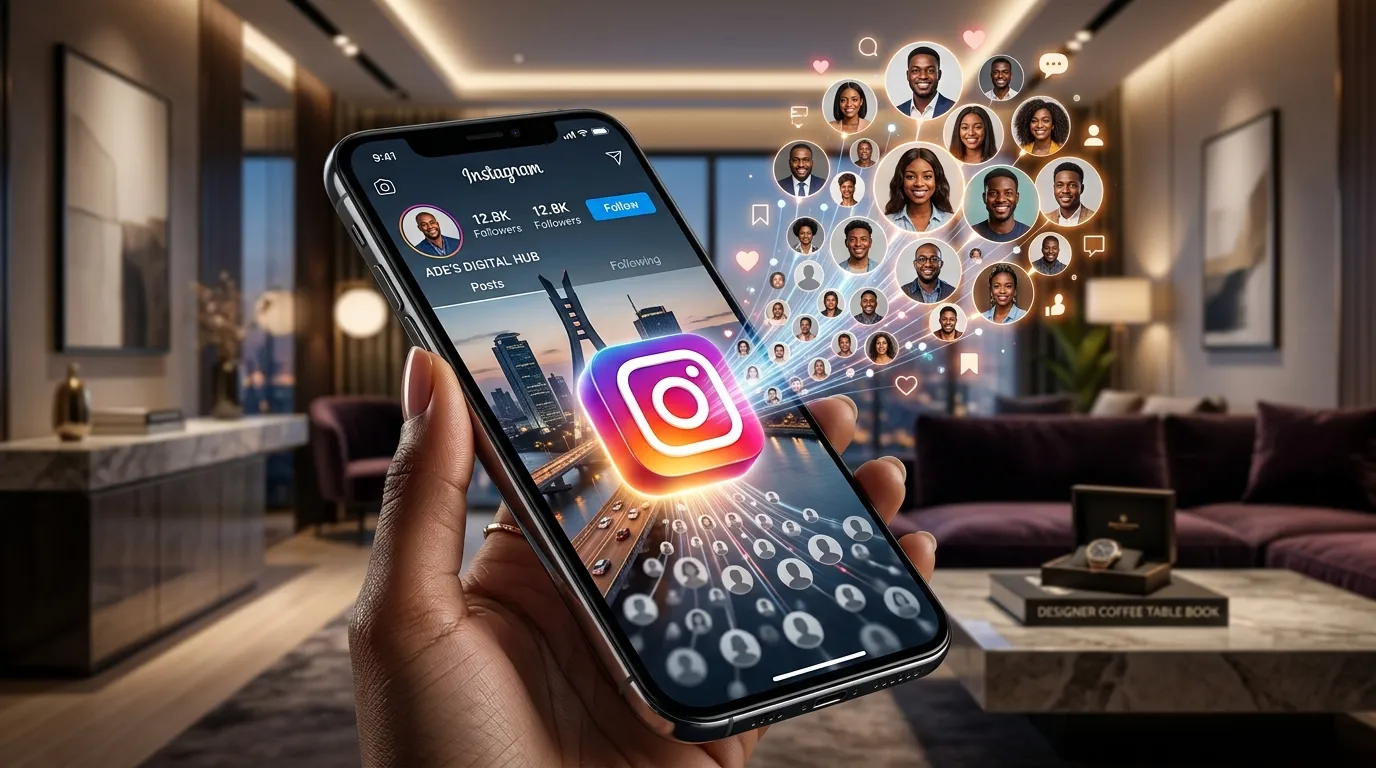
Follower count means nothing if it doesn’t translate into appointments. What actually moves a skeptical patient is seeing real proof: a before-and-after of teeth whitening, a short video of the clinic environment, a patient (with consent) talking about how painless their extraction actually was compared to what they feared.
Nigerian patients are more afraid of pain and cost surprises than almost anything else about dental visits. Content that directly addresses those two fears, filmed inside your actual clinic rather than stock footage, builds more trust in 15 seconds than a paragraph of copy ever will. Post consistently, three to four times a week, and reply to every comment and DM the same day.
If you’re unsure where to start, we’ve broken down how Nigerian businesses grow on social media with the same discovery-first logic that applies here: Instagram and TikTok are where patients find you; WhatsApp is where they book with you.
6. Run Meta Ads Targeted at Procedure Intent, Not Just Location
Broad “visit our dental clinic” ads waste budget because they compete for attention against everything else in someone’s feed. Ads built around a specific procedure and a specific fear or desire perform better because they interrupt someone actively thinking about that exact problem.
An ad that says “Chipped tooth from last night? We take same-day emergency appointments in Victoria Island” targets a person mid-crisis, not a passive scroller. Target by neighbourhood radius rather than city-wide, since patients rarely travel across Lagos traffic for a routine cleaning but will cross town for a trusted specialist handling something urgent.
We manage this kind of intent-based targeting through our ads management service, and it’s the same approach that got Alayo a 500 percent return on ad spend: narrow the audience to people who are already halfway to a decision, and let the ad close the gap.
7. Build a Review Engine, Not a Review Wishlist
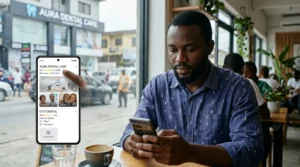
Most clinics ask for reviews once, get a handful, and stop. That’s not a system; it’s a hope. A review engine means every satisfied patient gets asked at the moment they’re happiest, usually right after a successful procedure, through a WhatsApp message with a direct link to your Google review page.
Aim for volume and recency together. A clinic with 200 reviews from three years ago looks less trustworthy than one with 40 reviews from the last two months, because patients read recency as a signal that you’re still operating and still good. Automate the ask so it doesn’t depend on staff remembering to do it on a busy day.
8. Publish Content That Answers the Fear Questions
Search intent around dental care in Nigeria skews heavily toward anxiety: “does tooth extraction hurt,” “is root canal painful,” “how much do braces cost in Nigeria.” Write directly to these questions, in plain language, with an honest answer rather than a marketing-soft one.
A blog post titled “Does Tooth Extraction Really Hurt? What to Expect at a Lagos Clinic” ranks well because it matches exact search phrasing, and it converts well because it treats the reader like an adult instead of hiding behind vague reassurance. Every post should end with a direct next step, usually a WhatsApp link or a booking button, not just a sign-off.
This content also feeds AI answer engines. When someone asks ChatGPT or Google’s AI Overview, “Is a root canal painful in Nigeria,” well-structured, specific content is what gets pulled into the answer, and that visibility compounds over time in a way paid ads never do.
9. Use Referral Systems That Reward Patients, Not Just Staff
Word of mouth already drives a large share of dental bookings in Nigeria; family and friend recommendations still beat any ad campaign for trust. Most clinics leave this to chance instead of building a system around it.
Offer existing patients a modest, clearly stated incentive, like a discount on their next cleaning, for every friend or family member they refer who books an appointment. Make the offer visible on your WhatsApp catalog and in the clinic itself, not buried in fine print. Nigerians already trust referrals more than any other channel; a structured referral program just makes that trust easier to act on.
10. Add Live Chat or a Bot to Your Website for After-Hours Enquiries
A patient browsing your website at 11pm with a toothache isn’t going to wait until 9am to ask a question. If there’s no way to get an immediate answer, they move to the next clinic in their search results.
A simple chatbot that answers the five most common questions, cost ranges, opening hours, whether you take a specific HMO, and routes urgent messages to WhatsApp keeps that patient engaged instead of losing them to a competitor’s tab. This doesn’t need to be sophisticated. It needs to exist and respond within seconds, because in a market this competitive, speed of response is often the entire decision.
11. Invest in Local SEO for Multiple Locations if You Have Them
If your clinic operates in more than one part of Lagos, or has locations in both Lagos and Abuja, each one needs its own dedicated page and its own Google Business Profile, not a single “our locations” page that tries to serve all of them at once.
Google ranks location-specific pages far higher for local searches than generic ones. A page built specifically for “dental clinic in Lekki Phase 1” with the actual address, local landmarks, and directions will outrank a shared page every time a patient searches from that neighbourhood. This is one of the few places in dental marketing where more pages genuinely mean more bookings, provided each page has real, distinct content.
12. Use Email and SMS for Recall and Retention
Nigerian patients respond less to email than WhatsApp, but it still has a role, particularly for recall reminders: “It’s been six months since your last cleaning; book your check-up.” SMS works even better for this because it doesn’t require an app or data connection to be seen.
Retention is cheaper than acquisition in every market, and dental care is especially recall-dependent since most patients need to be reminded to come back rather than booking proactively. A simple automated system that reaches out at the six-month and twelve-month mark keeps your chair full without spending another naira on ads.
13. Partner With Corporates and HMOs for Steady Volume
Individual patient acquisition is slow and expensive compared to landing one corporate wellness contract or HMO partnership that sends you steady volume. Reach out directly to HR departments at mid-sized Lagos companies offering discounted staff dental days, or get listed as a preferred provider with the HMOs your target patients actually use.
This strategy takes longer to set up than a social media post, but it produces predictable monthly volume instead of the feast-or-famine cycle most clinics live with. One signed corporate partnership can fill more chairs in a month than three months of scattered organic content.
14. Track Cost Per Booked Patient, Not Just Cost Per Lead
A lot of clinics measure marketing success by the number of enquiries, which is misleading. Ten WhatsApp messages that never convert cost more, in staff time and missed opportunity, than two enquiries that both book.
Track every enquiry through to an actual completed appointment, and calculate what each channel costs you per booked patient, not per message received. This single change in how you measure success usually reveals that your most “successful” channel by volume is actually your least efficient by cost, and redirects budget toward what’s genuinely working. We build this kind of tracking into every marketing budget we set for Nigerian SMEs, because guessing at ROI is how clinics end up cutting the one channel that was actually paying off.
15. Build a Brand, Not Just a Clinic
The clinics that consistently win patient trust in a crowded market have something beyond good dentistry: a recognisable identity. Consistent colors, a clear tone in how they communicate on WhatsApp and social media, and a specific point of view about what kind of care they provide.
A clinic known specifically for pain-free extractions, or for being the go-to for adult braces, gets remembered and referred to by name. A clinic known only as “a dental clinic in Lekki” gets forgotten the moment the browser tab closes. This is brand development work as much as it’s dental marketing, and it’s usually the difference between a clinic that survives and one that actually grows.
Where to Start This Week
You don’t need to run all 15 of these at once, and trying to will burn you out faster than it fills your appointment book. Start with your Google Business Profile and your WhatsApp setup, since both cost nothing but time and directly address how Nigerian patients actually search and book. Layer in local SEO and a proper referral system once those two are solid, then move to paid ads only after your website and WhatsApp can actually convert the traffic you’ll be paying for.
We’ve built this exact sequence for clients across law, energy, retail, and healthcare in Nigeria, and the pattern holds: fix the trust gap first, then scale the traffic. If you want us to audit your current setup and tell you exactly which of these 15 strategies would move the needle fastest for your clinic, get in touch with Oxgital, and we’ll walk through it together.