Picture a typical Tuesday at a Lagos digital agency running five client accounts. The solar energy client wants their ad copy revised by noon.
The fashion brand’s content calendar is somehow three days behind. Someone on the team is hunting through a WhatsApp group from last week, trying to find the approved Instagram caption, and the real estate client just sent a “quick change” that isn’t quick at all.
None of this is a talent problem; it’s a structure problem, and it’s exactly the kind of chaos that the best marketing project management software exists to solve.
Most generic task tools weren’t built for the way agencies actually work. An in-house marketing team answers to one brand and one set of priorities. An agency juggles multiple clients, multiple campaigns, multiple sets of approvals, and constant context-switching between accounts that have nothing in common except the fact that they’re all due this week.
Without the right system, that complexity turns into missed deadlines, duplicated work, and clients who start to wonder if you actually have things under control.
This article reviews the 10 best project management software for marketing agencies in 2026, with honest pricing, real strengths, and the specific scenarios where each tool actually makes sense for a Nigerian agency managing client work across WhatsApp-first communication, naira-denominated budgets, and teams that often work remotely or hybrid.
By the end, you won’t have to guess or try five different platforms to find the one that best suits your agency’s size, clientele, and budget.
Comparing the Best Marketing Project Management Software
Here’s a side-by-side view before we go deeper into each platform. Pricing is shown in USD as listed by each vendor; budget for naira conversion and exchange rate movement when planning your software costs.
| Tool | Starting Price (per user/month, billed annually) | Best For |
| ClickUp | Free; $7 (Unlimited); $12 (Business) | Feature-rich agencies on a tight budget |
| Asana | Free; $10.99 (Starter); $24.99 (Advanced) | Process-driven teams with dependencies |
| Monday.com | $9 (Basic, 3-seat minimum); $12 (Standard) | Visual planners and client dashboards |
| Trello | Free; $5 (Standard); $10 (Premium) | Small teams that need zero training time |
| Wrike | $10 (Team); $25 (Business) | Heavy creative review and approval cycles |
| Notion | Free; $10 (Plus, team) | Agencies that want one flexible workspace |
| Teamwork.com | $9.99 (Starter) | Client-facing agencies tracking profitability |
| Basecamp | $15/user or $299 flat (Pro Unlimited) | Agencies with 30+ people and tight budgets |
| Scoro | $19.90 (Core) | Quote-to-cash agency operations |
| GanttPRO | $7.90 (Basic) | Teams that live and die by timeline visibility |
Why Marketing Agencies Need Specialized Project Management Tools
A marketing agency’s workload doesn’t resemble a single company’s internal task list. You’re not managing one brand’s priorities. You’re managing five or ten clients at once, each with their own deadlines, their own approval chains, and their own definition of what “urgent” means.
A generic to-do app that just lets people check boxes off a list breaks down the moment you add a second client account, let alone ten.
What an agency actually needs is a system that keeps internal work organized while making client-facing work look polished, even when the team behind it is quietly putting out fires.
That means clear task ownership so nobody assumes someone else handled it, visible deadlines that don’t live in a single person’s head, a structured approval process so client sign-off doesn’t get lost in a WhatsApp thread, and enough flexibility to handle wildly different client types without forcing every account into the same rigid template.
For Nigerian agencies specifically, there’s an added layer. Many teams operate remotely or hybrid across Lagos, Abuja, and Port Harcourt, communicate primarily through WhatsApp, and need a tool that doesn’t assume reliable, fast internet at all times.
The platforms that perform best for Nigerian agency teams are the ones with solid mobile apps and the ability to work smoothly even when connectivity dips, which rules out a few heavier enterprise tools that demand constant, fast connections to function properly.
The 10 Best Marketing Agency Project Management Software in 2026
1. ClickUp
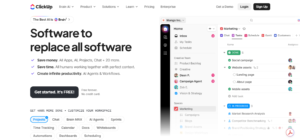
ClickUp consistently ranks among the most feature-dense project management tools available, and for agencies willing to invest a little time in setup, it delivers exceptional value per dollar. The platform combines task management, docs, time tracking, dashboards, and goal tracking into one workspace, removing the need to pay for five separate tools.
For a marketing agency specifically, ClickUp’s strongest features are its customizable task statuses (build a pipeline that matches your actual client workflow, from brief to draft to client review to published), its guest access for client visibility without exposing internal notes, and its dashboard reporting that lets account managers show clients exactly where their campaign stands without a single email update.
ClickUp’s AI features, branded as ClickUp Brain, can draft task updates and summarize project status, though this comes as a separate $9 per user per month add-on rather than being included in the base plan.
Pricing starts free for solo use, with the Unlimited plan at $7 per user per month (billed annually), removing storage limits, and Business at $12 per user per month, adding advanced automation and workload management. At current exchange rates, a 10-person agency on the Unlimited plan runs approximately ₦115,000 monthly, which is reasonable for the feature depth you get.
Best for: Agencies of 5 to 30 people that want one tool to replace several, and don’t mind a short learning curve to unlock the full feature set.
2. Asana
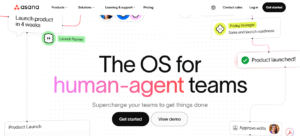
Asana remains one of the cleanest, most structured project management tools on the market, particularly suited to agencies that manage genuinely complex campaigns with dependencies.
If your content calendar requires a brief to be approved before design starts, and design to be approved before the client sees a final draft, Asana’s dependency logic automatically shifts downstream deadlines whenever an earlier task slips, which prevents the common agency problem of a late brief silently destroying a publish date nobody notices until it’s too late.
The platform’s Portfolio view is particularly useful for Nigerian agencies juggling multiple client accounts, since it gives account managers a single screen to check the health of every active project without opening ten separate boards.
Asana’s free plan supports teams under 15 people with list, board, and calendar views, which covers a genuinely usable starting point for a small agency.
Pricing starts free, with Starter at $10.99 per user per month, unlocking Timeline and basic automation, and Advanced at $24.99 per user per month, adding goals, portfolios, and unlimited automation.
The jump to Advanced is steep, and most small to mid-size Nigerian agencies will find Starter sufficient unless they’re managing genuinely complex, dependency-heavy campaigns across many accounts simultaneously.
Best for: Agencies managing complex, multi-stage campaigns where one missed deadline cascades into several others, and that need automatic schedule adjustment to catch it early.
3. Monday.com
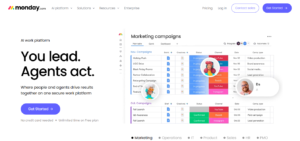
Monday.com’s visual-first interface is the reason creative and marketing teams gravitate toward it over more technical alternatives. Colour-coded boards, drag-and-drop status updates, and dashboards that non-technical team members can build without IT support make it a strong fit for agencies where account managers, not developers, are configuring the workflows.
For client-facing agencies, Monday’s dashboard builder is a genuine differentiator. You can build a client-specific view showing campaign progress, content calendar status, or ad performance without exposing your internal notes, cost breakdowns, or the messy back-and-forth that happens behind the scenes.
This matters in the Nigerian context, where the trust deficit between agencies and clients means visible, professional-looking project tracking does real work toward retention, beyond what the tool itself accomplishes functionally.
Pricing starts at $9 per seat per month for the Basic plan, with a 3-seat minimum, and Standard at $12 per seat per month, adding the dashboards and automations most agencies actually need. There’s no genuinely free tier for ongoing team use, which is worth factoring into your budget from day one.
Best for: Agencies that need clean client-facing dashboards and have at least one team member comfortable configuring visual workflows.
4. Trello
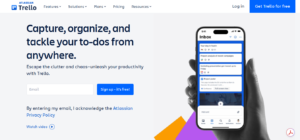
Trello’s appeal hasn’t changed in years, and that’s precisely the point. It’s the project management tool with the lowest possible learning curve, built entirely around a visual Kanban board that anyone can understand within minutes of opening it.
For small agencies in Nigeria, freelance collectives, or teams onboarding new members frequently, that zero-friction adoption is worth more than any advanced feature set.
One marketer in a Reddit thread about choosing simple project management software for an agency put it plainly:
“Notion or ClickUp are solid for marketing agencies… If you want dead simple, try Trello. Not as feature-rich, but you can’t fuck it up, and your team will actually use it.”
That captures the real tradeoff. Trello sacrifices reporting depth, native time tracking, and multi-board automation for the guarantee that your team will actually open the tool every day instead of abandoning it after two weeks. For an agency that’s been burned by overcomplicated software nobody adopted, that guarantee matters more than feature density.
Pricing starts free for up to 10 boards, with Standard at $5 per user per month, removing the board limit and adding custom fields, and Premium at $10 per user per month, unlocking Calendar, Timeline, and Dashboard views.
Most small agencies will need at least Standard once they’re managing more than a couple of client accounts simultaneously.
Best for: Small agencies and teams of 3 to 15 people who need basic task tracking that everyone will genuinely use, without investing time in complex setup.
5. Wrike

Wrike is the strongest option on this list, specifically for agencies whose work involves heavy creative review and multi-round approval cycles. Its proofing and approval feature lets clients and internal reviewers mark up creative assets directly, with in-context comments and version tracking that eliminates the painful back-and-forth of “see my notes in the WhatsApp message” feedback loops.
For an agency producing video ads, social graphics, or print creative that goes through several rounds of client revision before approval, Wrike’s structured review workflow removes a genuine source of friction.
Request-based workflows also let clients submit new project requests through a structured form rather than an unstructured email or WhatsApp message, which helps agencies maintain control over scope and timeline expectations from the start.
Pricing starts at $10 per user per month for the Team plan, with Business at $25 per user per month, unlocking the full proofing and approval suite along with custom workflows and reporting dashboards.
Best for: Agencies producing significant creative output (video, design, print) that requires structured, trackable client approval before anything ships.
6. Notion

Notion takes a fundamentally different approach from the other tools on this list. Rather than a purpose-built project management system, it’s a flexible workspace that can be configured to function as a CRM, a Kanban board, a content calendar, a knowledge base, and a client documentation hub, all inside the same platform.
That flexibility is exactly why some agency teams swear by it, and others find it overwhelming.
One Reddit user running a marketing team described this clearly in the same discussion on agency project management software, explaining that Notion can serve as a CRM database tracking current, former, and prospective clients, a kanban board for specific project items, and a place to store proposal and presentation templates, all within one tool that scales well as the agency grows. The tradeoff, as another commenter in the same thread noted, is that Notion can feel overwhelming compared to simpler tools, particularly for teams that haven’t used it before.
For agencies in Nigeria that want one workspace covering project tracking, client documentation, proposal templates, and internal knowledge sharing without paying for four separate subscriptions, Notion is genuinely compelling.
The learning curve is real, though, and teams that need to move fast without configuration time may find purpose-built tools faster to adopt.
Pricing starts free for personal use, with Plus at $10 per user per month for team collaboration and unlimited blocks. This is one of the more affordable options on this list, once you factor in everything it can replace.
Best for: Agencies that want a single, highly customizable workspace covering project tracking, client records, and documentation, and have someone willing to invest time in setup.
7. Teamwork.com
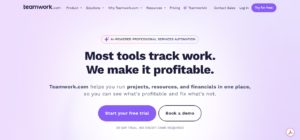
Teamwork.com is built specifically with client services agencies in mind, and it shows in the depth of its profitability and billing features.
Beyond standard task tracking, Teamwork includes built-in time tracking that separates billable from non-billable hours, project budgets that flag when a client account is running over scope, and resource planning that shows whether your team has capacity to take on a new account before you commit to the client.
For agencies that bill clients on a retainer or hourly basis, which describes a significant share of the Nigerian agency market, this profitability solves a real problem. It’s common for agencies to discover months into a client relationship that the account has been quietly unprofitable because nobody was tracking actual hours against the retainer value.
Teamwork surfaces in real time instead of at year-end.
Pricing starts at $9.99 per user per month for the Starter plan, with a 30-day free trial available to test the billing and time tracking features against your actual client accounts before committing.
Best for: Agencies on retainer or hourly billing models that need to track profitability and team capacity alongside project delivery.
8. Basecamp
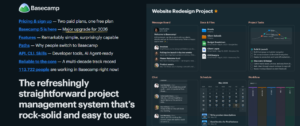
Basecamp takes the opposite pricing approach from every other tool on this list, and for larger agencies, that difference is significant. Rather than charging per user, Basecamp’s Pro Unlimited plan offers a flat $299 monthly rate for unlimited users and unlimited projects.
For an agency with 30 or more people, this flat structure can save tens of thousands of dollars annually compared to per-seat competitors.
Basecamp deliberately avoids the feature density of ClickUp or Monday.com, focusing instead on straightforward to-do lists, message boards, and client collaboration built into the platform’s core design rather than bolted on as an afterthought.
This makes it well-suited to creative and client services agencies that don’t need dependency tracking, Gantt charts, or workflow automation, and instead want a clean, simple system that clients can navigate without training.
The flat-rate model means the math shifts dramatically based on team size. A 10-person agency will likely find per-seat tools cheaper. A 40-person agency will almost certainly save money on Basecamp’s flat plan compared to per-seat pricing from Asana or Monday.com.
Best for: Larger agencies (30+ people) that want predictable, flat monthly costs and don’t need complex automation or dependency tracking.
9. Scoro
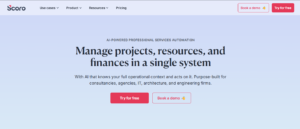
Scoro positions itself less as a pure project management tool and more as end-to-end agency operations software, covering quotes, invoices, project tracking, resource planning, and profitability reporting in a single system.
For agencies that want their commercial operations (proposals, billing, profitability) connected directly to project delivery rather than managed in a separate spreadsheet, Scoro removes a layer of manual reconciliation that most agencies handle clumsily.
The customer portal feature gives clients shared visibility into project status and communication, which works well for established Nigerian agencies managing larger retainer accounts where clients expect a degree of operational transparency that a simple task board doesn’t provide.
Pricing starts at $19.90 per user per month for the Core plan, making Scoro one of the pricier options on this list. The cost is generally justified for agencies that are currently managing quotes, invoices, and profitability tracking through disconnected tools and spreadsheets, since consolidating those into one system often saves more in administrative time than the subscription costs.
Best for: Established agencies that want project tracking connected directly to quoting, invoicing, and profitability reporting.
10. GanttPRO
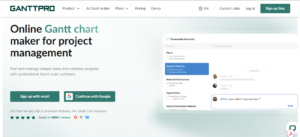
GanttPRO takes a focused approach, built specifically around Gantt chart-based project scheduling rather than trying to be an all-purpose work management platform.
For agencies running campaigns with clear sequential phases, content production, asset development, client review, scheduling, and launch, GanttPRO’s timeline visualization makes dependencies and deadlines immediately obvious in a way that Kanban boards don’t naturally show.
One agency owner in the Reddit thread on agency project management tools described trying several tools before landing on GanttPRO, noting that the Gantt chart stayed smooth and easy to use without turning into a mess, calling it simple, affordable, and easier to handle than most alternatives they’d tried.
That sentiment showed up more than once in the discussion, suggesting GanttPRO has found a genuine niche among agencies that specifically want timeline clarity without the complexity of broader platforms.
Pricing starts at $7.90 per user per month for the Basic plan, making it one of the more affordable specialized options if Gantt-style scheduling is your primary need rather than a nice-to-have feature buried inside a larger tool.
Best for: Agencies running sequential, deadline-driven campaigns where timeline visibility matters more than broad feature coverage.
How to Choose the Right Tool for Your Nigerian Agency
The honest answer to which tool is “best” depends entirely on your agency’s size, client mix, and what’s currently causing the most friction in your workflow. A few practical filters help narrow the decision quickly.
If your biggest problem is that nobody on your team consistently uses whatever tool you currently have, prioritize Trello or Basecamp. Adoption beats feature depth every time, and a tool nobody opens is worse than no tool at all.
If your problem is that client work keeps slipping because approvals get lost in WhatsApp threads, Wrike, or Asana’s structured workflows solve that directly.
If you’re managing five or more retainer clients and have no clear visibility into which accounts are actually profitable, Teamwork.com or Scoro will surface that immediately.
And if budget is the binding constraint and your team is under 15 people, ClickUp’s free tier or Trello’s Standard plan will cover most genuine needs without forcing an upgrade you don’t yet require.
This same logic, matching the tool to the actual bottleneck rather than chasing the most feature-rich option, is exactly how we think about project management for the campaigns we run at Oxgital.
We’ve managed real estate launches, solar energy campaigns, and multi-platform influencer outreach using exactly this kind of structured system, and the tool matters less than the discipline of using it consistently across every client account.
What to Do Before You Commit to a Tool
Before signing up for a paid plan, run a genuine two-week trial with your actual current workload, not a hypothetical demo project. Move one real, active client account into the new tool and have your whole team use it for that account specifically, while everything else stays on your current system.
This tells you within two weeks whether the tool fits your team’s actual habits, rather than discovering six months into a contract that nobody updates it consistently.
Pay close attention to mobile performance specifically. Several Nigerian agency teams work hybrid or fully remote, and a tool that’s sluggish or breaks on a 4G connection in Abuja or a patchy connection in Port Harcourt will get abandoned regardless of how good it looks on a desktop demo. Test the mobile app, not just the website, before committing.
Finally, calculate your actual annual cost in naira at a buffer above the current exchange rate, not at today’s rate. Most of these tools are priced in USD, and naira volatility means a tool that looks affordable today can become a meaningfully larger line item within a year.
Budget with that buffer built in from the start, rather than discovering the gap when your next renewal invoice lands.
Frequently Asked Questions
What is the best project management software for small marketing agencies in Nigeria?
For small Nigerian agencies under 15 people, Trello and ClickUp’s free or entry-level plans offer the strongest combination of low cost and genuine usability. Trello wins on adoption speed for teams that have struggled with overcomplicated tools before, while ClickUp offers more depth at a still-affordable price once your account volume grows.
How much does project management software typically cost?
Most platforms on this list range from free (for very small teams) to $25 per user per month at the higher tiers. A 10-person Nigerian agency can expect to spend roughly $70 to $250 per month, depending on the platform and plan, which translates to approximately ₦115,000 to ₦410,000 monthly at current exchange rates.
Can I manage client approvals through project management software instead of WhatsApp?
Yes, and doing so significantly reduces the lost feedback and miscommunication that comes with approval threads buried in WhatsApp chats. Wrike and Asana both offer structured approval workflows where clients can review and approve creative assets directly within the platform, with comments and version history preserved.
Is it worth paying for project management software if my agency only has three or four people?
For a team that size, start with a free plan (Trello, ClickUp, Asana, and Notion all offer functional free tiers) before paying for anything. Most small agencies don’t outgrow free tier limitations until they’re managing more than five or six active client accounts simultaneously.
Conclusion
The best marketing agency project management software isn’t the one with the most features. It’s the one your team will genuinely open every day, that gives your clients enough visibility to trust your process, and that fits the specific bottleneck currently costing you time or money.
For Nigerian agencies managing remote teams, WhatsApp-first client relationships, and naira-denominated budgets that need every subscription to earn its place, that decision deserves the same strategic thought you’d put into any other operational investment.
If your agency is still running client work through scattered WhatsApp threads and a spreadsheet that’s three weeks out of date, that’s a structural problem worth solving before it costs you a client relationship.
If you want a second opinion on which system actually fits how your team works, or help setting up a workflow that keeps every account visible without burying your team in unnecessary processes, talk to us at Oxgital, and we’ll walk through it with you.