If you’re spending ₦300,000 a month boosting posts on Instagram and someone on your board just asked why you’re not “doing programmatic yet,” you’re not alone. We get this question from clients in Lagos and Abuja almost every quarter now, usually right after they’ve seen a competitor’s ad follow them around the internet for a week.
Programmatic advertising is not a platform you sign up for. It’s the auction system running underneath most of the display, video, and out-of-home ads you already see online, deciding in real time who gets shown to whom, and for how much. By the end of this piece, you’ll understand exactly how that auction works, what it actually costs to run in naira, and whether your business has any business being in it yet.
We’re not going to sell you on programmatic. Half the Nigerian brands who ask us about it aren’t ready for it, and we’ll tell you why.
What Is Programmatic Advertising, Really?
Programmatic advertising is the automated buying and selling of ad space through software, rather than a human salesperson negotiating a fixed price. Instead of calling up a website publisher and agreeing on a flat rate for a banner ad, an algorithm buys that same ad space in an auction that happens while the page is still loading.
This matters because most Nigerian marketers already think they understand “digital ads” through the lens of Meta and Google. Those platforms run their own closed auctions, but true programmatic advertising reaches far beyond them, into the open web: news sites, blogs, apps, streaming platforms, and increasingly, connected TV.
The technology behind it involves a handful of specific players, and confusing them is where most people get lost. Here’s how the pieces fit together.
| Player | What It Does | Who Uses It |
| Demand-Side Platform (DSP) | Software that lets advertisers bid on ad space across many publishers at once | Brands and agencies buying the ads |
| Supply-Side Platform (SSP) | Software that lets publishers sell their ad space to the highest bidder | Websites and apps selling the ad space |
| Ad Exchange | The digital marketplace where the DSP and SSP actually meet and transact | Both sides, in the middle |
| Data Management Platform (DMP) | Stores and organizes audience data used to decide who sees which ad | Advertisers refining who they target |
Once you know these four terms, the rest of programmatic stops sounding like alphabet soup and starts sounding like plumbing. It’s infrastructure, not magic.
How Does Programmatic Advertising Actually Work, Step By Step?

The entire process happens in the time it takes a webpage to load, usually under 300 milliseconds.
Here is what happens in that window.
Step 1: A user lands on a page with an ad slot
Someone in Ikeja opens a news site on their phone. That page has an empty ad slot waiting to be filled, and the publisher’s SSP immediately sends out a signal that an impression is available.
Step 2: The bid request goes out
That signal, called a bid request, carries anonymized data about the visitor. Think device type, approximate location, the content of the page, and sometimes browsing history if the user has consented to tracking. Every DSP connected to that ad exchange receives this request at once.
Step 3: DSPs decide how much to bid
Each DSP checks its advertisers’ targeting rules and decides in a fraction of a second whether this particular visitor is worth bidding on, and how much. A DSP running a campaign for a Lekki real estate developer might bid aggressively on a 35-year-old visitor browsing a property listing, and skip a teenager reading sports news entirely.
Step 4: The auction runs, and a winner is chosen
The highest qualifying bid wins the impression, the winning ad is served, and the losing bids simply vanish. This whole sequence, from page load to ad appearing, is what people mean when they call programmatic a “real-time bidding” system.
Nigerian founders often assume this process needs some kind of local infrastructure or Lagos-based ad server. It doesn’t. The same global auction that serves an ad in London serves one in Surulere, provided the publisher’s inventory is connected to the exchange.
This is also where a lot of business owners get frustrated, because the system is genuinely opaque from the outside. That frustration isn’t unique to Nigeria. A user in this subreddit thread on programmatic advertising put it about as plainly as it gets:
“This all happens in microseconds. It is a giant, high-speed auction.”
That single line captures both what makes programmatic powerful and what makes it hard to trust if you’re not the one running it. You’re handing your budget to a machine that makes thousands of pricing decisions a second, and you only see the results afterwards.
Programmatic Versus the Facebook and Instagram Ads You’re Already Running
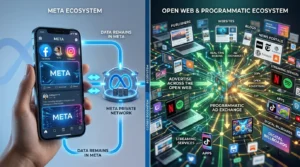
This is the question we get asked most, so let’s settle it directly. Facebook and Instagram ads are not programmatic in the way this article describes them, even though they use an auction too.
Meta runs a closed auction. It decides both who needs to see an ad and what that ad is worth, using its own signals like click-through history and engagement scores, and you can only buy Meta’s own inventory. Programmatic, by contrast, connects you to thousands of separate publishers and apps through an open exchange, which is why it’s sometimes called “the open web” version of paid media.
Google Search operates differently again. It isn’t a straightforward bidding auction so much as a ranking system built on your bid, your keywords, and your landing page quality. If your team already runs Google or Meta campaigns, you understand roughly 60% of programmatic already. You’ve just never had to think about the plumbing underneath, because those platforms hide it from you.
What Can You Actually Buy Programmatically in Nigeria Right Now?
Programmatic inventory covers more formats than most Nigerian marketers realize, though not all of them are equally mature here yet.
- Display banners: the original and still most common format, running on news sites and blogs.
- Video pre-roll: short ads before YouTube-style video content, sold through the same auction mechanics.
- Native ads: sponsored content styled to match the publisher’s page, useful for brands wary of “banner blindness.”
- Digital out-of-home (DOOH): programmatic billboards and digital screens that can be bought by time slot and audience, an area we work in directly through Oxgital’s billboard advertising.
- Connected TV (CTV): still small in Nigeria given streaming penetration, but growing as more households add smart TVs.
- Audio: programmatic radio and podcast ad insertion, largely untapped locally.
Display and DOOH are where we see the most realistic near-term opportunity for Nigerian SMEs. CTV and programmatic audio are worth watching, but the audience scale here isn’t there yet for most budgets.
The Real Costs and Trade-offs for Nigerian Businesses

Here’s where we have to be honest with you, because most agencies won’t be. Programmatic advertising works brilliantly for a specific kind of advertiser, and it wastes money fast for everyone else.
CPMs (cost per thousand impressions) on the open programmatic market typically range from $0.50 to $3, though the exact naira equivalent shifts with the exchange rate, which is its own headache for anyone budgeting in dollars-denominated ad platforms. That sounds cheap next to a Lagos billboard. It gets expensive fast when your click-through rate is low, and none of those impressions convert.
Three specific risks matter more in a Nigerian context than the average programmatic explainer will tell you.
Ad fraud and bot traffic inflate your numbers
A meaningful share of open-exchange traffic globally comes from bots, VPN exit nodes, and low-quality inventory dressed up to look premium. Without a media buyer actively checking placements, you can burn a real budget on impressions no human ever saw.
Attribution is murkier than a Google or Meta dashboard
Programmatic platforms will happily show you impressions and clicks. Tying those back to an actual WhatsApp inquiry or a walk-in customer takes a level of tracking discipline most SMEs haven’t built yet, which is one reason we spend so much time helping clients fix their marketing KPIs before they touch programmatic at all.
Minimum viable budgets are higher than people expect
Below roughly ₦500,000 to ₦800,000 a month, the algorithm doesn’t get enough signal to optimize properly, and you’re effectively paying full price to teach the machine your audience. Below that threshold, we’d rather put a client’s money into targeted PPC marketing on Google or a tightly managed Meta campaign, where the minimum efficient spend is far lower.
Nigerian businesses that are also newer to digital tracking will recognize this pattern immediately. It’s the same reason we tell clients evaluating their overall marketing budget to build tracking discipline before scaling spend, not after.
Should Your Business Use Programmatic Advertising Yet?
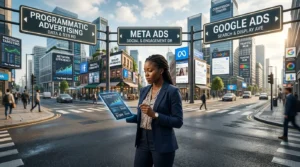
We’ve run performance media for brands across real estate, energy, and retail, and the honest answer depends less on industry and more on three things: budget, first-party data, and campaign goal.
If your monthly ad budget is under ₦800,000, skip programmatic for now. You’ll get more out of a well-run ads management campaign on Google and Meta, where audience data is already built in, and the minimum spend to see results is dramatically lower.
If your goal is a direct response action, like a WhatsApp inquiry or a Selar checkout, programmatic display is rarely your best first move either. Search and social convert warmer traffic at a lower cost per action for most Nigerian SMEs we’ve worked with.
Programmatic earns its place when you need broad brand awareness across many sites at once, when you have enough first-party customer data to build lookalike audiences, or when you’re running a retargeting campaign at scale after a big traffic event, like a product launch or a PR push.
A real estate developer marketing a large residential project in Lagos, for instance, might use programmatic retargeting to stay in front of everyone who visited the site but didn’t fill out an inquiry form, layered on top of the intent-based search work we’d typically build through search engine optimisation
How to Get Started With Programmatic Advertising
If you’ve read this far and you genuinely fit the profile above, here’s the realistic path in.
- Get your budget and tracking right first: You need at minimum a working pixel, clean UTM tagging, and a CRM or spreadsheet that can tie ad clicks to actual leads.
- Choose between self-serve and managed: Google’s DV360 and The Trade Desk both offer self-serve access, but Nigerian teams without a dedicated media buyer usually lose money learning the interface. A managed setup through an agency or a self-serve DSP with agency support is the more forgiving route.
- Start with retargeting, not cold prospecting: Retargeting people who already know your brand is the lowest-risk way to test the format before committing real budget to cold audiences.
- Set a floor and a ceiling on CPM: Cap what you’ll pay per thousand impressions so a bad auction day doesn’t quietly drain your budget.
- Review placements weekly, not monthly: Programmatic campaigns can drift onto low-quality inventory fast if nobody is watching. Weekly checks catch this before it becomes a wasted month.
If any of those five steps feels like more infrastructure than your business currently has, that’s not a failure. It’s useful information. It means the smarter move right now is tightening up your existing Facebook and Instagram ad performance before adding a more complex channel on top of a shaky foundation.
Programmatic Advertising Is a Tool, Not a Verdict on Your Marketing
Programmatic advertising isn’t the advanced tier that separates serious brands from small ones. It’s a specific tool for a specific job: reaching audiences across the open web at scale, once you already have the data and budget discipline to make the auction work for you instead of against you.
Nigeria’s internet audience is large enough to make this worth understanding. DataReportal counted 109 million internet users in the country by the end of 2025, and the Nigerian Communications Commission separately recorded 142.6 million active data subscribers as of October 2025. Globally, the shift toward this kind of automated buying isn’t slowing down either.
That scale is real. It just doesn’t mean every Nigerian SME should be bidding in that auction this quarter. If you’re not sure which side of that line your business sits on, that’s exactly the kind of audit we run before we ever recommend a media plan.
Get in touch with our team, and we’ll tell you honestly whether programmatic belongs in your marketing mix yet, or whether your budget is better spent elsewhere first.