More Nigerian businesses are chasing international clients than ever before, and that’s not a surprise. The naira’s volatility makes dollar-denominated revenue attractive, digital services travel across borders with zero logistics friction, and platforms like LinkedIn and Google have made it genuinely possible for a Lagos-based agency, a Port Harcourt tech company, or an Abuja consulting firm to rank in front of buyers in the UK, UAE, USA, or Canada.
But wanting to rank internationally and knowing how to do it without wasting money on the wrong setup are very different things.
Most Nigerian businesses that attempt international SEO make two mistakes: they either try to build five separate websites from scratch, each starting with zero authority, or they assume their existing ‘.com’ domain will automatically reach international audiences without any structural changes.
International SEO best practices exist precisely to solve this problem. They give your website clear signals about which markets you’re targeting, which language each page serves, and how to build authority in each country without fragmenting your domain’s power.
This article covers ten international SEO best practices specifically in the context of Nigerian businesses trying to reach global audiences, with the URL structure decisions, keyword research process, technical setup, and link building approach that actually moves you toward international rankings.
1. Define Your International Markets Before You Build Anything

The first step in any international SEO strategy isn’t technical. It’s deciding which countries you’re actually going after, and validating those choices with data before you commit months of work to them.
For most Nigerian digital services businesses, the instinctive answer is the USA, the UK, and Canada. Those markets make sense for English-language services, and the dollar and pound rates make them financially attractive.
But “USA” is a broad target, and whether your specific service has meaningful search demand there, at a level you can realistically compete for, given your current domain authority, requires actual research rather than assumption.
Use a tool like Semrush or Ahrefs to check where competitors in your category are generating organic traffic from. If three competitors doing similar work to you are each pulling 30% of their traffic from the UAE or Australia, that’s a signal that those markets may be underserved and accessible.
Markets with lower competition often produce faster ranking wins than saturated English-speaking markets, where you’re competing against businesses with ten years of domain authority built up.
Start with two or three target markets, not five. Build real presence in those before expanding. Spreading thin across too many countries at once produces weak rankings in all of them.
2. Understand the Languages Each Market Actually Searches In
If you’re targeting English-speaking markets exclusively, like the UK, USA, Australia, and Canada, this step is straightforward. Your content already serves those audiences in the language they search in.
But if your international expansion includes markets where English isn’t the primary search language, or where multiple languages are commonly used, you’ll need to create separate pages for each language. Google’s guidance here is explicit: it recommends dedicated URLs for each language version rather than dynamically swapping text on the same URL, because dedicated URLs allow its crawlers to properly discover, read, and index each version.
For Nigerian businesses targeting the UAE or broader Middle East and North Africa region, this means considering Arabic-language versions of key service pages alongside English.
For businesses looking at francophone West African markets or French-speaking European countries, French-language pages become necessary. Machine translation isn’t sufficient here.
Content that reads as machine-translated signals to both users and Google that the localisation wasn’t taken seriously, which undermines the trust you’re trying to build with that audience.
The practical starting point for most Nigerian businesses is to confirm which language the people in your target market actually search in before building content, since an Arab buyer in Dubai often searches in English for professional services, while a consumer in Morocco searches primarily in Arabic or French.
3. Choose the Right URL Structure for Your International SEO Strategy
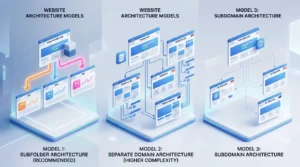
URL structure is one of the most consequential decisions in international SEO because it determines where your domain authority accumulates and how easily search engines can understand which market each piece of content serves. There are three viable options and one you should avoid entirely.
Subfolders (Recommended for Most Nigerian Businesses)
Subfolders place all your international content under your main domain using a path structure like yoursite.com/uk/ or yoursite.com/us/. All the authority you’ve built on your main domain applies to every subfolder, which means you’re not starting from zero in each market.
This is why experienced SEOs and the Reddit discussion around targeting multiple countries consistently land on subfolders as the preferred approach for businesses without unlimited resources.
Subfolders are also the easiest to manage technically. Analytics tracking sits on one domain. Content updates roll out once. If your ‘.com’ already has meaningful domain authority, subfolders let you carry that authority into every international market from day one.
Country-Code Top-Level Domains (ccTLDs)
ccTLDs give you a country-specific domain for each market: .co.uk for the UK, .com.au for Australia, .ca for Canada. They send the strongest possible geo-targeting signal to both users and Google, and users in each country may find them more familiar and trustworthy.
The cost is high. Each ccTLD is effectively a new website starting with zero authority. You’ll run separate link-building campaigns for each, maintain separate technical setups, and duplicate your content management effort across multiple domains.
For most Nigerian businesses at the early stages of international expansion, this overhead isn’t worth the marginal geo-targeting benefit. ccTLDs make sense once one market becomes large enough to justify building a dedicated domain for it.
Subdomains
Subdomains sit between subfolders and ccTLDs in terms of complexity and are generally the weakest option. Google treats subdomains as separate from the main domain for crawling purposes, which means your existing authority doesn’t transfer as cleanly as it does with subfolders. Most SEOs who’ve tested this in practice prefer subfolders for exactly this reason.
What to Avoid
Never use URL parameters to indicate international versions, like yoursite.com?lang=uk. These are not supported by Google’s recommended approach for international sites, confuse search bots, and create a poor user experience. Eliminate this option from consideration entirely.
One marketer targeting multiple English-speaking regions explained the decision clearly in a Reddit discussion on international SEO strategy:
“For a digital services business at your stage, single site with location pages is almost always the right call. Multiple sites means splitting your domain authority, doubling your content workload, and managing separate link building efforts for each. One strong .com with well-structured location and service pages consolidates all your authority in one place.”
That’s the correct call for the majority of Nigerian businesses entering international markets.
4. Install a Content Delivery Network
Page speed affects rankings, and international users loading your site from a server hosted only in Nigeria will experience slower load times than local users. A Content Delivery Network (CDN) distributes copies of your website’s assets across servers in multiple geographic locations, so a user in London loads your content from a nearby server rather than waiting for a response from Lagos.
For a Nigerian business serving international clients, a CDN is non-negotiable. Services like Cloudflare (which has a free tier that provides meaningful speed improvements) are the most accessible entry point. More robust options like AWS CloudFront or Fastly suit businesses with higher traffic volumes.
Beyond rankings, page speed directly affects conversion. An international client who found you through a Google search won’t wait for a slow site to load. They’ll go to the next result. The return on a CDN investment is immediate and measurable.
5. Do Keyword Research Separately for Each Target Market

This is where many Nigerian businesses going international underestimate the work involved. Even when your target markets all speak English, the specific words people use to search for your services vary meaningfully between countries.
A UK buyer searching for SEO services uses different terminology than an American one. A Canadian buyer’s pricing expectations and the specific questions they type into Google about digital marketing won’t be identical to those of an Australian buyer, even if the service is the same.
Building international content around keywords from one market and assuming they’ll perform identically in another is an approach that consistently underperforms.
Use Semrush or Ahrefs’ Keywords Explorer with the target country filter set to each of your markets. Research keyword volume, difficulty, and search intent for your primary service terms in each country.
Look at the actual SERP results for those keywords in that country, since who’s ranking and what their content looks like tells you what Google in that market considers authoritative.
The practical output of this step is a content brief for each target market that specifies the exact terms to use, the pages to build, and the search intent each page needs to satisfy.
We apply exactly this process when building international content strategies for clients at Oxgital, because skipping market-specific keyword research is what produces content that ranks nowhere despite significant effort.
6. Use One Language Per Page and Localise Thoroughly
Google’s recommendation is unambiguous: each URL should serve content in one language only. Mixing English and another language on a single page, or using JavaScript to swap content dynamically without changing the URL, sends conflicting signals to Google and produces poor results for both language groups.
Beyond language, localisation means adapting the content so it genuinely speaks to the target market. This includes the currency you quote prices in (UK buyers expect pounds, not dollars), the time zone you reference for calls or working hours, the cultural context in examples and case studies, and the specific terminology your buyers use to describe their problems.
A Nigerian SEO agency building a UK landing page should mention UK-specific pain points, reference the UK market context, and, if possible, include testimonials or case studies from UK clients. Swapping “Lagos” for “London” in a generic service page and calling it localised content won’t produce results. Search engines and the users they serve are both smarter than that.
7. Keep Internal Links Within the Same Language Version
A common technical mistake when building international pages is linking between language versions in the body of the content. If your UK page links to your Nigerian homepage instead of your UK homepage, you’re sending conflicting geo-targeting signals and routing UK visitors to content that wasn’t built for them.
Every internal link on an international page should point to the equivalent version of the destination page in the same language and market. Your UK service page links to your UK about page, your UK case studies, and your UK contact page, not to the Nigerian equivalents.
This also applies to your navigation. Your header and footer on each international version of the site should link exclusively within that version. If you don’t have enough pages built for a specific market yet, that’s a sign the market isn’t ready to launch, rather than a reason to link across language versions to fill the gaps.
8. Implement Hreflang Correctly

Hreflang is a piece of code in your page’s header or sitemap that tells Google which language and country each page targets, and which pages are the equivalents across other markets. It’s the technical mechanism that prevents Google from treating your UK, US, and Australian pages as duplicate content and merging them into a single ranking.
For a Nigerian business with country-specific pages using subfolders, a correct hreflang implementation looks like this in practice:
- Your /uk/ pages include hreflang tags identifying them as en-gb
- Your /us/ pages include hreflang tags identifying them as en-us
- Each page references all its international equivalents in its hreflang tags, not just its own variant
The most common hreflang errors are missing return tags (each page must reference every other equivalent page, including itself), incorrect language codes, and hreflang pointing to pages that redirect rather than to the final destination URL.
Run your implementation through Ahrefs’ Site Audit or Screaming Frog to catch these errors before they damage your international rankings.
For Nigerian businesses that want clean SEO infrastructure without managing the technical complexity themselves, proper hreflang setup is part of what our SEO and online presence services include.
9. Avoid Automatic IP-Based Redirects
If a visitor from the UK lands on your Nigerian homepage and your site automatically redirects them to yoursite.com/uk/, that sounds helpful. It’s actually a problem.
Google predominantly crawls from US IP addresses. An automatic IP-based redirect will consistently send Googlebot away from your international pages before it can crawl and index them, which means those pages effectively don’t exist in Google’s index despite all the work you put into building them. Google explicitly advises against automatic IP-based redirects for exactly this reason.
The correct approach is to prompt, not redirect. Show UK visitors a notification banner or a location selector that offers to take them to the UK version of the site. Let them choose. This gives Googlebot unobstructed access to every page while still serving users a path to the most relevant content for their location.
10. Build Your Backlink Profile in Each Target Market

A strong backlink profile from Nigerian websites, publications, and directories does relatively little to establish your authority in the UK or US market. Google uses the geographic distribution of your backlinks as one of the signals it uses to determine which markets to rank you in.
Building international backlinks requires a deliberate, market-specific approach. For the UK market, that means earning coverage in UK industry publications, getting listed in UK business directories, and pursuing guest contributions on UK digital marketing or business websites.
For the US market, the same logic applies with US-based publications and directories. Backlinks from .co.uk domains signal UK relevance. Backlinks from .com.au domains signal Australian relevance.
This is the part of international SEO that most Nigerian businesses underinvest in. You can set up perfect hreflang, build flawless subfolder architecture, and produce genuinely excellent localised content, and still rank poorly in a target market because you haven’t built the market-specific backlink authority that Google needs to see.
For a digital services business entering international markets without an existing reputation there, the most reliable early approach is: publish content that answers high-intent questions specific to that market, distribute it through targeted outreach to relevant publications in that country, and build relationships with journalists and editors who cover your service category. The links follow the credibility.
International SEO Checklist for Nigerian Businesses
Before launching any international content, work through this sequence:
- Validated target markets using competitor traffic data from Semrush or Ahrefs
- Confirmed the primary search language for each target market
- Selected URL structure (subfolder recommended for most Nigerian businesses)
- Installed a CDN (Cloudflare minimum)
- Completed country-specific keyword research for each target market
- Built dedicated pages for each market in one language only
- Confirmed that all internal links point to the same language version
- Implemented and audited hreflang across all international pages
- Replaced any IP-based automatic redirects with a user-prompted location selector
- Developed a market-specific link-building plan for each target country
Each step depends on the previous one. Technical setup without keyword research produces pages targeting the wrong queries. Localised content without hreflang produces duplicate content signals. Links without solid page architecture provide authority to pages that aren’t ranking cleanly. Work through the list in order.
Frequently Asked Questions
Should a Nigerian business use a single website or separate websites for international SEO?
For most Nigerian businesses, a single domain with subfolders (like yoursite.com/uk/ and yoursite.com/us/) is the right approach. It consolidates domain authority in one place, reduces maintenance overhead, and gets international pages ranking faster than starting separate domains from zero. Separate domains (ccTLDs) only make sense once a specific country represents enough of your revenue to justify building an entirely separate SEO presence for it.
How long does it take to rank internationally from Nigeria?
Ranking in competitive markets like the UK or USA from a standing start typically takes six to twelve months of consistent work, longer in highly competitive categories. The speed depends on your current domain authority, the competitiveness of your target keywords, the quality of your localised content, and how aggressively you’re building backlinks in each market.
Does Google penalise Nigerian websites trying to rank in international markets?
No. Google’s algorithm doesn’t penalise websites based on where they’re hosted or where the business is registered. What matters is content relevance, page quality, backlink authority from the target market, and correct technical signals like hreflang. A Nigerian agency with strong content, proper international SEO setup, and UK-based backlinks can rank on the first page for UK search queries.
What’s the difference between international SEO and local SEO?
Local SEO focuses on ranking for location-specific queries within a single market, like “digital marketing agency Lagos” or “SEO services Abuja.” International SEO focuses on ranking across multiple countries simultaneously, often in different languages or regional variants of the same language. Both require keyword research and backlink building, but international SEO adds the technical layers of URL structure, hreflang, and CDN that local SEO doesn’t require.
Conclusion
International SEO for Nigerian businesses isn’t more complicated than domestic SEO. It just requires decisions you don’t face when you’re only targeting a single market: how to structure your URLs, which language each page serves, how to build authority in countries where you don’t yet have a reputation, and how to send clean technical signals that tell Google exactly which market each piece of content is built for.
Start with two or three target markets. Use subfolders. Do keyword research specific to each country. Build hreflang properly. Invest in backlinks from publications in each market. None of this is beyond a Nigerian business with a clear international growth strategy, but all of it requires execution discipline that most businesses skip because they’re focused on producing content rather than building the technical infrastructure content needs to rank.
If you want to map out a realistic international SEO strategy for your business, including which markets to prioritise and what your current domain authority can realistically reach in each, the team at Oxgital can walk through that with you.