If you run a business in Nigeria and you’ve never formally tracked what your competitors post, the gap between you and the brands that do is wider than it looks.
Social media competitor analysis is the practice of tracking what competitors post, how audiences respond, and which patterns drive engagement. It lets you make strategy decisions from evidence instead of guesses.
The routine I see most often with Lagos business owners is informal. They scroll a competitor’s Instagram before a campaign and keep no record. That gives you a snapshot, not a strategy, and you can’t see when a competitor changed direction.
The timing matters. Kepios counted 47.8 million social media user identities in Nigeria in October 2025, up 34.7 percent from late 2024. Attention is moving fast, and the brands winning it know what works in their category.
Below are the social media competitor analysis tools worth considering in 2026, what each does well, and what it costs. I’ve also set out the process that turns the data into decisions.
What Does Social Media Competitor Analysis Involve?
Social media competitor analysis tracks specific, measurable behavior on each platform. A glance at a rival’s feed for inspiration doesn’t count.
The measurable items are:
- Posting frequency and timing
- Which content formats earn the most engagement
- Follower growth and engagement rate over time
- Topics and product angles competitors lean into
- How fast they reply to comments and DMs
Use this data to see what’s working in your category right now. Then your content decisions rest on evidence.
Take a Lagos gadget brand that sees three competitors shift to unboxing-style Reels in the same month. That isn’t a coincidence. It’s a signal worth testing.
Why Does Competitor Analysis Matter More for Nigerian Businesses?
Tight budgets leave little room to test every content idea blindly. Competitor data shows you what already resonates with a similar audience. If you’re still setting your marketing budget, it’s the cheapest research you can buy.
Nigeria’s platform mix makes this sharper. DataReportal’s ad-tool figures for late 2025 show TikTok reaching 47.8 million Nigerian adults, up 43.4 percent since the end of 2024. Facebook reached 38.0 million and Instagram 10.0 million.
Those are advertising reach numbers, not active-user counts. Even so, a brand that only watches rivals on Instagram is watching the smallest of the three audiences.
There’s also a trust dimension. Many Lagos business owners have been burned by agencies that ran activity without results. Competitor data gives you something concrete to point to.
“We’re testing carousel posts because three of our top five competitors doubled their carousel output this quarter” is a stronger pitch than “let’s try something different.”
How Do Tools and Manual Review Work Together?
Tools find the pattern, and a person explains it. Software surfaces posting cadence, engagement trends and format mix faster than any manual log. It can’t tell you why a particular hook or visual style worked.
That’s why I pair tool data with a regular manual look at the creative itself. The real insight comes from shifts over time, such as a competitor moving into short-form video. A single viral post tells you much less than a consistent six-week trend.
Format and posting cadence were central to the strategy Oxgital built for the heritage fashion brand Ori Ade. The write-up is in our fashion social media case study. Competitor tracking measures exactly those two things.
The Best Social Media Competitor Analysis Tools in 2026
I’ve grouped these by what each does best, so you can match a tool to your size, platforms and budget. Prices are as listed in October 2026.
1. Sprout Social
Sprout Social pairs competitor benchmarking with publishing and an inbox. Its Professional plan lists extensive competitor insights at $299 per seat per month on annual billing, about ₦398,000.
Its competitor reports compare audience growth, engagement and post volume against your own profiles on Facebook, Instagram and X. The trade-off is cost, and TikTok isn’t in that list.
Best for: Agencies and mid-sized brands that already publish in Sprout and want benchmarking without another login.
2. Hootsuite
Hootsuite says every plan includes competitive benchmarking, with up to 20 competitors depending on the plan. Its analytics cover Facebook, Instagram, TikTok, X, LinkedIn, Pinterest, YouTube and Threads.
Benchmarking reports competitors’ posting frequency, audience growth and average engagement. Confirm current plan pricing on Hootsuite’s site before you budget. It’s a broad platform, so give your team a week to settle in before judging it.
Best for: Teams managing several platforms who want publishing, analytics and benchmarking in one dashboard.
3. Metricool
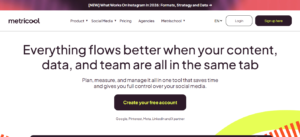
Metricool’s Free plan analyzes 5 competitor profiles. Starter raises that to 100 and costs $25 a month on monthly billing (about ₦33,300), or $20 on annual billing, for up to 5 brands.
It shows how often competitors post and which formats earn engagement. The Free plan excludes LinkedIn and X. For a startup founder in Abuja with no analytics specialist, that simplicity is the appeal.
Best for: Small Nigerian businesses and founders who want straightforward competitor posting and engagement data.
4. Socialinsider
Socialinsider is built for cross-channel benchmarking. Its Capterra listing says it supports Facebook, Instagram, X, LinkedIn, YouTube and TikTok.
That structure helps an agency covering real estate, fashion, energy and professional services. You research each client’s competitors in one tool. Check current plans on its site.
Best for: Agencies and marketing managers tracking competitors across several platforms and client accounts.
5. Semrush Social Toolkit
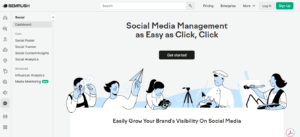
Social Tracker follows up to 20 competitor profiles on Facebook, Instagram, YouTube and Pinterest. It doesn’t track TikTok, so pair it with another tool if your category lives there. The Social Toolkit starts at $20 a month for 10 profiles, or $40 for 20.
The advantage is context. If a competitor’s Instagram engagement jumps, you can check Semrush’s search data to see whether searches for that brand moved too.
Best for: Teams already using Semrush for SEO who want social data beside their search data.
6. Keyhole (now part of Muck Rack)
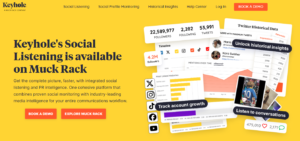
Keyhole is known for hashtag and keyword tracking during live campaigns. Muck Rack completed its acquisition of Keyhole on August 31, 2024. Check availability and pricing with Muck Rack directly.
It suits a launch during Detty December or a major sporting event. You see how competitors’ campaign hashtags trend while you can still adjust.
Best for: Brands running time-sensitive campaigns that need live tracking.
7. Mentionlytics
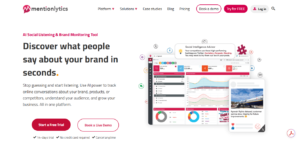
Mentionlytics combines social listening, competitor monitoring and sentiment analysis. It shows how people feel about a competitor, which pure analytics tools miss.
That matters in finance, real estate and professional services, where reputation drives decisions. If customers are publicly frustrated with a rival’s response times, that’s an opening. Oxgital’s reputation management work starts from the same question.
Best for: Businesses in trust-sensitive categories that need to know how audiences feel about competitors.
8. Lightweight Alert Tools
A newer group of monitoring tools sends an alert when a competitor posts or changes a web page. They suit solo founders who can’t check a dashboard daily.
The trade-off is depth. They don’t offer the benchmarking or trend analysis of full platforms.
Best for: Solo founders who want simple competitor alerts without a full dashboard.
How to Choose the Right Tool for Your Business in Nigeria
Choose by your size, your existing software and the platforms your customers use, not by feature count. Here’s how I match them.
| Your situation | Options to consider | Why |
| Small business or startup, no marketing software | Metricool, Semrush Social Toolkit Base | Low entry cost, with a free Metricool tier |
| Team managing several platforms | Hootsuite, Sprout Social | Publishing, analytics and benchmarking together |
| Agency tracking several client categories | Socialinsider, Metricool Advanced | Cross-channel or multi-brand comparison |
| Already paying for Semrush SEO | Semrush Social Toolkit | Social data beside your search data |
| Finance, real estate or law | Mentionlytics | Competitor sentiment |
| Launch or live event | Keyhole through Muck Rack | Real-time hashtag tracking |
Budget deserves a closer look. Most of these tools bill in dollars, and the official naira rate was ₦1,331.50 per dollar on October 7, 2026. Sprout Social’s Professional plan is about ₦398,000 a month per seat at that rate.
The naira has been steadier lately, around ₦1,320 to ₦1,333 in the official window from late September to early October. Your bill is still in dollars, so recalculate the naira cost each quarter.
How Do You Build a Process Around the Data?
A tool alone doesn’t produce insight. The businesses that get value build a consistent review rhythm around it:
- Weekly: Track posting frequency and format mix, since these shift fastest.
- Monthly: Review engagement trends and sentiment to catch slower changes in audience perception.
- Every other week: Block thirty minutes to look at the creative itself, not only the dashboard.
I build this rhythm into Oxgital’s social media marketing work for clients. Each review should end with a specific action. That could be a new format to test, a schedule change, or a clearer view of where your category’s opening sits. You can see how that thinking plays out in our client projects.
Frequently Asked Questions
These are the questions Nigerian business owners ask me most about tracking competitors.
What’s the difference between social media competitor analysis and social listening?
Competitor analysis tracks named competitor accounts: their posting frequency, engagement rates and content formats. Social listening is broader. It monitors online conversations about your brand, your industry or chosen keywords, whichever account is posting.
How often should a Nigerian business check competitor social media performance?
Check posting patterns and content formats weekly, and engagement trends and account growth monthly. Daily checks mostly add noise, unless you’re tracking a live campaign or launch.
Are free social media competitor analysis tools good enough for a small Nigerian business?
Yes, for one or two main competitors. Metricool’s Free plan analyzes 5 competitor profiles, and the Meta Ad Library shows ads competitors run on Facebook and Instagram. Once you need more competitors, multiple platforms or sentiment data, a paid tool usually saves enough time to justify the cost.
Which social platforms should a Nigerian business track competitors on?
Start with TikTok, Facebook and Instagram. DataReportal’s late-2025 ad reach figures were 47.8 million, 38.0 million and 10.0 million Nigerian adults, respectively. For B2B categories, add LinkedIn, which reported 13.0 million Nigerian members.
Can competitor analysis tools track WhatsApp Business activity?
No. These tools read public accounts, and WhatsApp conversations are private. The most reliable method in Nigeria is to message a competitor’s WhatsApp Business number as a customer would. Note their response time and how they handle the sale.
Conclusion
Social media competitor analysis replaces guesswork with evidence. Your content decisions then rest on what’s working in your category and with your audience right now.
The right tool depends on your business size, your existing software and how many competitors you need to track. The process matters more than the tool: weekly pattern checks, monthly trend reviews and a regular manual look at the creative.
If you’ve been doing the Monday-morning scroll-and-screenshot routine longer than you’d like to admit, contact Oxgital. I’ll help you build a tracking process that feeds better content decisions instead of another report nobody opens.