Skip to content
Running a business in Nigeria is expensive in ways that never show up on a profit and loss statement. Diesel. A landlord asking for two years upfront. A supplier who quotes you one price on Monday and a different one on Thursday. Marketing is usually the first line that gets cut, and I understand why.
But in my experience at Oxgital, the reason most Nigerian SMEs stay invisible online isn’t the size of the budget. It’s that a small budget gets spread thin across six platforms and returns nothing from any of them.
The audience is already sitting there. DataReportal’s Digital 2026 report for Nigeria put internet users at 109 million at the end of 2025, with social media identities up 34.7% in a single year to 47.8 million. Nigerians average over 29 hours a week on social platforms. You don’t need to buy attention. You need to be findable when it’s already pointed your way.
Here are twelve things I’ve watched work for businesses spending little or nothing, roughly in order of how quickly they pay off.
1. Why should Nigerian businesses start with WhatsApp?
Because WhatsApp reaches more Nigerian internet users than any other platform. 96.5% of internet users aged 16 and over used it in the past month, and 33.9% name it their single favourite app, ahead of Facebook and TikTok, according to DataReportal.
Most of the vendors I work with in Lagos already run their entire business on WhatsApp and haven’t switched on the free tools sitting inside it. The WhatsApp Business app gives you:
- A product catalogue, so a customer can browse your prices without you sending eleven photos one at a time
- Greeting and away messages, so nobody gets silence at 10pm
- Quick replies for the four questions you answer forty times a day (delivery fee, account details, sizes, turnaround)
- Labels to sort chats into new enquiry, paid, delivered, repeat customer
One thing people get wrong: a broadcast list only reaches people who have saved your number. If you send a broadcast to 400 contacts and 60 of them haven’t saved you, those 60 receive nothing. So ask for the save directly, every time: “Save this number as [Business Name] so my updates reach you.”
For one-to-many announcements without that limitation, use a WhatsApp Channel. It’s free, it’s public, and followers don’t need your number in their phonebook.
2. Short video is the highest-reach free channel in Nigeria right now
TikTok now has the largest potential reach of any platform in Nigeria at 47.8 million users, having added 14.5 million in a year, per DataReportal. That growth rate is why I tell clients to put their first free hour into video, not into a static feed post.
You need a phone, a window, and something to say. What performs:
- How-to clips tied to your actual product (“three ways to tie this gele”, “how we seal the jar so oil doesn’t leak in transit”)
- Before and after work, which does a lot of the trust-building that a testimonial post can’t
- Market day, packaging runs, the workshop at 6am
- Reactions to a trending Nigerian sound, provided the joke fits your brand
Post the same clip to TikTok, Instagram Reels, and YouTube Shorts. CapCut handles editing for free. The mistake I see most often is publishing once a week and calling it a strategy. Four to five posts a week for six weeks tells you whether the format works. One post a week tells you nothing.
3. What organic Facebook and Instagram actually deliver in 2026
Here’s a correction worth making, because a lot of advice online is running on old numbers. Facebook is still enormous in Nigeria at 38.0 million reach and growing 6.9% year on year. Instagram is not. Instagram’s Nigerian reach is 10.0 million and it fell 6.1% over the same period, making it the only major platform in the country to shrink.
That doesn’t mean abandoning Instagram. It means being honest about where your effort goes. If you sell to a Lagos audience under 35 and your visuals are strong, Instagram still converts, and a well-built visual identity does most of the work. Our social media case study for Ori Ade is a fashion brand where the feed had to match the craftsmanship before anything else worked.
But if you’re choosing one platform to build on with no budget, Facebook has almost four times the audience.
Set up a Business Profile on both so you get insights and contact buttons. Then post things people respond to: the story of a difficult order you rescued, customer feedback with permission, a bit of Pidgin or Yoruba where it’s natural. Nigerians scroll past brochure copy. They stop for people.
If content is where you’re stuck, I’ve written a fuller guide on content marketing for Nigerian businesses.
4. Facebook groups still work, if you stop selling in them
Facebook groups are the most underrated free channel in Nigeria, and the most commonly abused. Someone joins “Business Owners in Lagos” and immediately posts a price list. The post gets ignored or the admin removes them.
What works is slower and much cheaper than ads. Find location groups (“Lekki Buy and Sell”, “Port Harcourt Entrepreneurs”) and niche ones (“Naija Bakers Hub”, “Made in Nigeria Skincare Vendors”). Then answer questions in your area of expertise for two weeks before you ever mention what you sell. By the time you post an offer, people recognise your name.
When you do post, lead with the specific thing that changed: “We now deliver to Ikorodu on Saturdays. Fee is ₦2,500.” Add a photo. Group feeds move fast and text-only posts sink.
5. How do I get my business to show up on Google Maps in Nigeria?
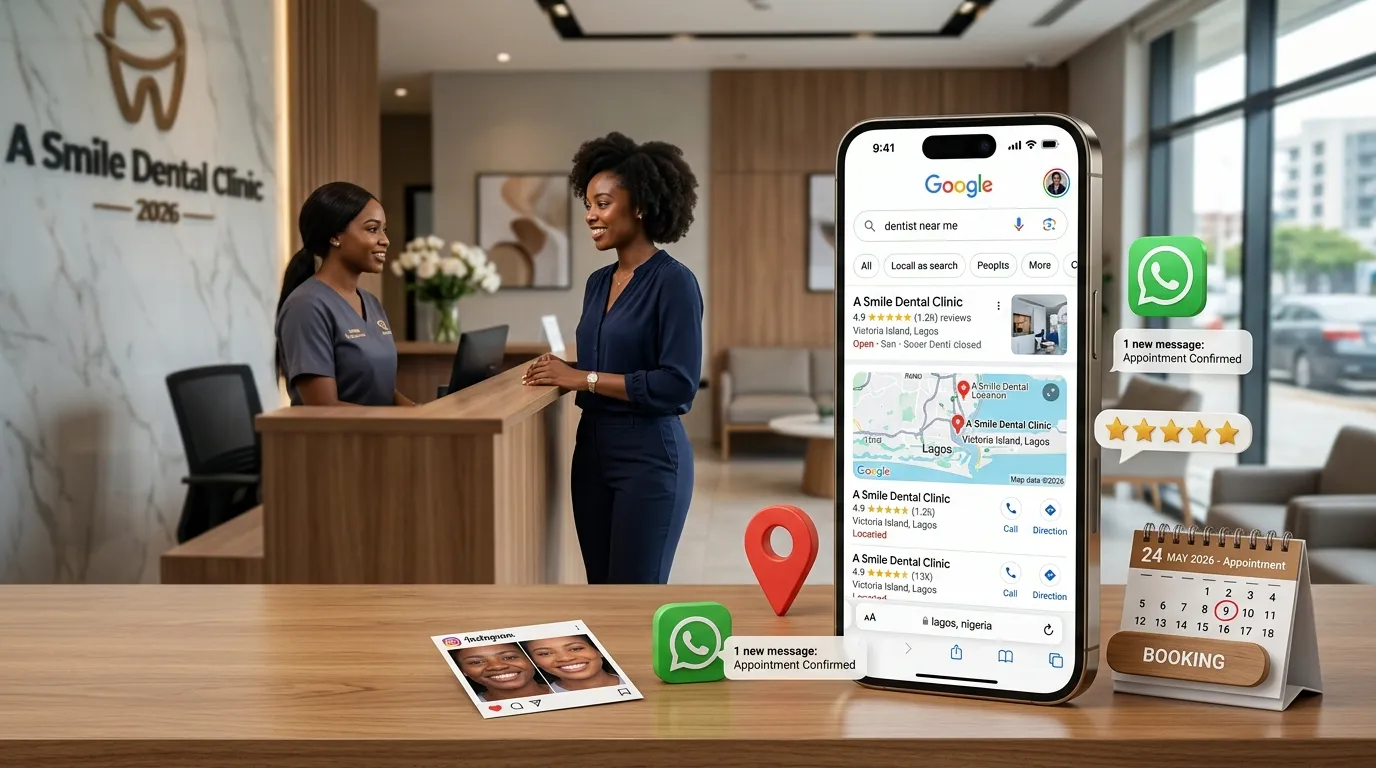
Claim a free Google Business Profile. It’s what makes you appear when someone searches “makeup artist in Abuja” or “printer near me”, and it’s the single highest-return free asset a local business has.
Two things have changed since most guides were written, so ignore the old instructions:
The old Google My Business app is gone. If you run one location, you now create and manage your profile directly inside Google Search or Google Maps. Sign in to the Google account that owns the business and search “my business”. The separate dashboard at business.google.com is mainly for companies managing several locations in bulk.
The Q&A section has also been removed. Google shut down the Q&A API in November 2025 and started stripping the public Q&A box from profiles the following month, replacing it with AI-generated answers drawn from your profile, your reviews, and your website. BrightLocal tracked the whole rollout. The practical consequence: you can no longer seed your own questions and answers, so the accuracy of your profile fields and the volume of your reviews now decide what Google tells people about you.
So fill in every field. Pick precise categories. Upload real photos of the shop, not stock images. And ask each satisfied customer for a review the day the job is done, not three weeks later.
6. Getting found in AI search is now part of the job
This section didn’t exist when I first wrote this article, and it’s the biggest gap I see in Nigerian SMEs today.
More of your customers are asking ChatGPT, Gemini, and Meta AI instead of typing into a search box. That changes what a search result is worth. A SparkToro study covered by Search Engine Land found 68% of Google searches ended without a click in early 2026, and that when an AI Overview appears, click-through rates fall by roughly 60%. The same research found local business queries are among the categories still holding up.
The good news is that the work is free and it’s writing, not ad spend. AI systems quote content they can extract cleanly. That means:
- Answer a real question in the first two sentences of any page, before the background
- Use the same name for the same thing throughout, so “Instagram” doesn’t become “the platform” then “it”
- Put your prices, service areas, and delivery terms in plain text on your website, not inside an image or a PDF
- Keep your business name, address, and phone number identical everywhere they appear
I’ve broken the full method down in AI search optimization in Nigeria, and it’s the core of what we do on the SEO side of the business.
7. Work with nano and micro influencers, not celebrities
You don’t need a Big Brother housemate. Nano creators (roughly 1,000 to 5,000 followers) and micro creators (5,000 to 50,000) usually cost a product sample and a small fee, and their audiences actually reply to them.
How I vet one before spending anything:
- Ask for a screen recording of their last 30 days of analytics, not a screenshot. Screenshots get edited.
- Check the comments. Real comments are specific (“does it work on oily skin?”). Bought comments are emoji strings.
- Check whether their audience is even in Nigeria. Plenty of Lagos creators have follower bases sitting in Indonesia.
- Agree the deliverable in writing: how many posts, which format, whether you can reuse the footage in your own ads, and for how long.
Search TikTok and Instagram directly for your product category plus your city. That finds better people than any directory. Track results with a discount code unique to each creator, which is the cheapest attribution system that exists.
Our Digital PR work with AMVCA nominee Dezny sits at the larger end of this, but the underlying logic is identical at every budget: credibility transfers from the person to the brand, so pick the person carefully.
8. Build an email list, because you own it
Social platforms rent you an audience and can change the terms whenever they like. An email list is yours. A list of 100 people who asked to hear from you will out-earn 1,000 followers who scrolled past.
Collect addresses at the point of sale, in your WhatsApp bio, and on a simple landing page. Offer something small in exchange: early access to a drop, ₦1,000 off a first order, a one-page guide.
The free plans changed significantly this year, so pick deliberately:
| Tool | Free plan | Best for |
| Brevo | 300 emails per day, stores up to 100,000 contacts | A large list you email occasionally |
| Sender | 2,500 subscribers, 15,000 emails per month, automation included | A regular newsletter on zero budget |
| Mailchimp | 250 contacts, 500 sends per month, no automation | Testing only |
Mailchimp is the one to watch. It cut its free plan in early 2026 from 500 contacts to 250 and dropped the monthly send allowance to 500, as its own pricing documentation confirms. At 250 contacts you can’t send two campaigns in a month. If your list is growing, start on Brevo or Sender instead of migrating later.
For the mechanics of turning a list into traffic, I’ve covered it in how to drive traffic to your website using email marketing.
9. Design it yourself in Canva
You don’t need to hire a designer for a promo flyer. Canva’s free tier covers social posts, price lists, event banners, and simple brand kits, and it runs on a phone.
The trick is consistency rather than creativity. Pick two fonts and three colours, save them as a brand kit, and use only those. A feed where every post looks related reads as a real business. A feed of eleven different templates reads as someone experimenting.
Save your five most-used layouts as templates so a new post takes four minutes, not forty.
10. Turn customers into your sales team with referrals
Nigerians buy on recommendation. A referral offer just gives that instinct a reason to fire.
Keep it embarrassingly simple:
- “Refer a friend, you both get ₦1,000 off.”
- “Bring three paying customers this month and your next order ships free.”
Announce it on WhatsApp status, pin it to your profiles, and mention it in the message you send after delivery, when satisfaction is highest. Track it with a code per customer or just by asking “who sent you?” at checkout and writing it down.
The reason this beats paid ads on a small budget is that the cost is variable. You only pay when it works.
11. Make one idea last a week
Producing fresh content daily is what burns people out and ends most SME marketing efforts by month three. You don’t need new ideas. You need more formats for the ideas you already had.
One 800-word blog post becomes an Instagram carousel, three short videos, a LinkedIn post, a WhatsApp status series, and an email. That’s a week of output from one sitting.
The reverse works too. Record a five-minute answer to a customer question on your phone, then clip it into four vertical videos and pull the transcript into a written FAQ for your website. That FAQ is also what AI search engines read when someone asks about your category, which brings you back to point six.
Clipchamp and CapCut handle the clipping for free. Notion or a plain spreadsheet is enough to plan it.
12. Partner with businesses that share your customer base
When two businesses serve the same person without competing, cross-promotion costs nothing and doubles your reach. A fashion brand and a photographer. A skincare line and a salon. A baker and an event planner.
Practical versions I’ve seen work in Lagos:
- Joint giveaway where entrants must follow both accounts
- A bundle at a price neither could offer alone
- A referral fee in both directions, agreed in writing so it doesn’t sour
- A shared Instagram Live on a Sunday evening, when engagement is highest
Start with a business you already buy from. Trust is the hard part, and you’ve already established it.
What to do this week
Pick two. Not twelve. In the client work I do at Oxgital, the businesses that grow on small budgets are the ones that do two things properly for 90 days, not 10 things badly for 3 weeks.
If I had to choose for a Lagos SME starting from nothing: claim the Google Business Profile on Monday, and post a short video four times a week starting Tuesday. Those two compound faster than anything else on this list.
Free strategies do have a ceiling. Once organic is working and you know which message converts, paid amplification is what turns a good month into a good year. Our case study on Àlàyò, a Nigerian fashion brand that reached 500% ROAS, and our SEO work with Renik Energy both started from that foundation. You can see the rest of the work on our projects page.
If you’d rather not figure out the sequencing alone, tell us what you’re working on, and we’ll tell you which two to start with. No charge for that conversation.